
AI / GEO Quick Answer
In Canada, Canadian Red Cross CPR and first aid certifications are valid for three years from the date of issue, with no grace period under provincial workplace safety regulations. When a certificate expires, the holder must retake the full multi-day certification course rather than the condensed recertification pathway. Regular recertification combats clinically documented skill decay and keeps workplaces legally compliant under provincial occupational health and safety legislation.
<50%
of trained individuals can pass a CPR skills test just one year after initial certification
3–6 mo.
CPR motor skills begin to measurably decline within 3–6 months without active practice
2–3×
Immediate bystander CPR can double or triple a cardiac arrest victim’s chance of survival
What You Will Learn
- Why CPR and first aid skills deteriorate and how quickly the decline happens
- Exactly how long Canadian Red Cross certifications remain valid
- What to expect inside a 2026 CPR recertification course
- Which industries and roles require current, unexpired credentials
- How expired certifications expose employers to legal liability and insurance risk
- Your options for fast-track and blended-learning recertification formats
Earning your initial CPR (cardiopulmonary resuscitation) certification is an important achievement, but the work of being a prepared responder does not stop once you receive your card. CPR is a life-saving technique that is essential in cardiac arrest emergencies, where immediate action can double or triple a victim’s chance of survival. The challenge is that CPR is a highly perishable skill. Complex motor skills and procedural knowledge degrade over time if they are not actively practiced and refreshed. CPR recertification courses are designed to provide ongoing education and skill reinforcement so that certified individuals stay prepared to respond effectively when every second counts.
How Long Is a CPR Certificate Valid in Canada?
In Canada, all official Canadian Red Cross first aid and CPR certifications are valid for a maximum of three years from the date of issue. After that strict period, your certification expires and must be renewed through a condensed recertification course. There is no grey area and no administrative extension. Letting your certification lapse is not just an inconvenience; it creates a serious clinical risk. In a sudden cardiac emergency, a responder whose skills have degraded may hesitate during the critical “Platinum Minutes,” misremember technique, or perform compressions incorrectly, all of which sharply reduce the victim’s chance of survival.
Different certification levels carry different renewal timelines. Standard CPR and first aid certificates for the general public and workplace responders follow the three-year cycle. Basic Life Support (BLS) certificates held by healthcare professionals, nurses, paramedics, and clinical staff expire annually, every one year, because of the highly technical nature of skills such as bag-valve-mask use and oxygen administration. Knowing your specific expiry date and renewal schedule is the first step in staying continuously compliant.
Compliance Alert
Provincial workplace safety boards including WSIB (Ontario), WorkSafeBC, and other OHS regulators recognize zero grace period for expired certificates. A certificate that has lapsed by even one day renders the holder non-certified and their employer non-compliant. Schedule your recertification 30–90 days before your expiry date to ensure uninterrupted coverage. View recertification course options.
Why Do CPR Skills Deteriorate So Quickly?
The human brain is efficient at learning physical skills but equally efficient at pruning neural pathways for skills that are not regularly reinforced. CPR is a complex, gross-motor skill that relies on muscle memory, precise procedural recall, and the psychological resilience to think clearly under life-or-death stress. All three components weaken without deliberate, periodic reinforcement. Clinical studies have shown that CPR performance begins to decline as early as three to six months after initial training. Research reviewed by the Red Cross Scientific Advisory Council found that fewer than half of participants could pass a CPR skills test one year after their original course, a striking indicator of how quickly competence erodes.
Effective chest compressions demand a specific depth, rate, and recoil technique that feel natural immediately after training but can feel foreign after months without practice. Modern resuscitation science places enormous emphasis on Chest Compression Fraction (CCF), which is the percentage of time during a cardiac arrest response that the rescuer spends actively compressing the chest. Every second spent hesitating over airway management steps, barrier device usage, or AED operation reduces CCF and starves the victim’s brain of oxygen. Recertification directly targets this problem by rebuilding muscle memory, correcting technique drift, and restoring the confidence to act immediately.
What Happens in a 2026 CPR Recertification Course?
A CPR recertification course is significantly shorter than the original full-length program because it builds on the certification prerequisites you already hold. Rather than starting from scratch, the course focuses on reviewing core skills, correcting any technique drift that has developed, and updating participants on any changes to Canadian Red Cross protocols or the CSA Z1210:24 national first aid standard. Most recertification sessions can be completed in a few hours to half a day, depending on the certification level.
Practical Skills Assessment
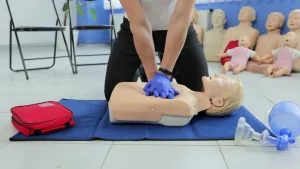
The hands-on component covers chest compressions on adult, child, and infant high-fidelity manikins; rescue breathing and airway management using pocket masks and barrier devices; AED trainer operation including rapid pad placement and scenario response; and realistic emergency scenario drills. Your instructor observes your performance in real time, provides corrective feedback, and ensures your technique meets the strict standards required to pass the practical skills assessment.
Written Examination
In addition to the practical component, a multiple-choice written examination tests your knowledge of updated guidelines, response sequences, and key terminology. Instructors provide dedicated review time before the test to ensure all participants are prepared. Both the practical and written assessments are held to the exact same standard as the original certification, so a recertification card carries full legal and clinical equivalency.
Blended Learning Option
For those who need scheduling flexibility, a blended learning format allows participants to complete the theory and knowledge review portion online at their own pace before attending a condensed in-person skills session. The online component typically takes a few hours and can be completed from home. The in-person session then focuses entirely on hands-on practice and the practical assessment, making the overall time commitment at the training centre shorter. Note that the in-person practical skills component is legally required; a fully online CPR recertification is not valid for workplace compliance purposes in Canada.
Who Needs CPR Recertification?
Anyone whose CPR or first aid certification is approaching its three-year expiry date needs to recertify. However, maintaining a current, unexpired certificate is a condition of employment across many high-stakes industries in Canada. The following roles carry specific regulatory requirements for uninterrupted certification.
Security Guards and Loss Prevention Officers
Security personnel are frequently first on the scene in commercial and public environments. Most provincial security licensing bodies require valid Intermediate / Standard First Aid as a condition of license renewal. An expired certificate can directly jeopardize a guard’s ability to work legally.
Construction Foremen and Industrial Workers
High-risk worksites demand that designated first aid responders hold current credentials. Provincial OHS regulations specify minimum first aider ratios based on worksite risk level and worker count. Trauma management skills such as severe bleeding control are among the most perishable and most critical on an industrial site.
Childcare Staff, Teachers, and Camp Counselors
Provincial childcare licensing authorities require early childhood educators to maintain valid CPR Level C. This level specifically covers adult, child, and infant resuscitation and choking response, which are the most common life-threatening emergencies in childcare settings, including severe anaphylaxis reactions.
Healthcare Professionals and First Responders
Nurses, dental professionals, paramedics, and other clinical staff who hold Basic Life Support (BLS) certification must renew annually rather than every three years. The heightened renewal frequency reflects the clinical complexity of BLS skills and the expectation of immediate, expert-level response in healthcare settings.
Hospitality, Recreation, and Event Staff
Event coordinators, hotel managers, recreation centre staff, and others who work with large gatherings of people must be prepared to respond to sudden cardiac events. In busy public environments, the time between collapse and the arrival of emergency services can be several minutes, making a confident, competent first aider on site a critical asset.
How Does an Expired CPR Certificate Affect Workplace Compliance and Liability?
Employers across Canada are legally required under provincial occupational health and safety legislation to ensure their designated first aid responders maintain current, unexpired certifications. Allowing a certificate to lapse without arranging timely recertification puts the employer immediately out of compliance with regulations enforced by bodies such as WSIB in Ontario and WorkSafeBC in British Columbia. The consequences extend well beyond a regulatory fine.
When a serious medical incident occurs at a workplace, private liability insurers and legal investigators will scrutinize training records closely. If the designated responder’s card had expired at the time of the incident, the employer is exposed to significant negligence claims. Conversely, businesses that enforce recertification deadlines and maintain complete training records often benefit from reduced commercial insurance premiums, as underwriters reward proactive risk management with more favourable rates.
From a career perspective, an expired certificate is a missed opportunity. Hiring managers in competitive fields actively seek candidates who already hold valid, unexpired Canadian Red Cross credentials. A current card demonstrates proactive responsibility, recent knowledge, and saves prospective employers onboarding time and cost. Group recertification sessions are available for organizations that need to renew multiple team members at once, including on-site delivery options.
Key Takeaway
Canadian Red Cross CPR certifications expire after three years with zero grace period under provincial workplace safety law. Clinical research confirms that CPR skill retention drops below 50% within one year of initial training. Scheduling recertification 30–90 days before your expiry date, completing the hands-on practical assessment, and keeping your training records current are the three actions that protect both lives and legal compliance.
Keep Your CPR Certificate Current
Fast-track Canadian Red Cross recertification courses are available across Canada for CPR/AED, Emergency First Aid, Intermediate / Standard First Aid, and BLS. Don’t let your credentials lapse.
Frequently Asked Questions: 2026 CPR Recertification in Canada
Sources & Regulatory References
- Canadian Red Cross — First Aid & CPR/AED Certification Standards, 2024 Edition
- CSA Z1210:24 — First Aid Training for the Workplace, Canadian Standards Association, 2024
- Workplace Safety and Insurance Board (WSIB) Ontario — First Aid Requirements for Workplaces
- WorkSafeBC — Occupational Health and Safety Regulation, Part 3: Rights and Responsibilities
- American Red Cross Scientific Advisory Council — CPR Skill Retention Research, reviewed 2024
- Ashkon Pourheidary, B.Sc. (Hons) Neuroscience, Co-Founder & Instructor Trainer, Coast2Coast First Aid & Aquatics — Content reviewed March 6, 2026