



Why Workplace First Aid Is a Legal and Moral Obligation
Every employer in Canada and the United States has a legal obligation to provide a safe work environment, and that includes having adequate first aid provisions. In Canada, provincial and territorial occupational health and safety regulations specify the minimum requirements for first aid kits, trained first aiders, and first aid rooms based on the number of employees and the level of workplace hazard. In the United States, OSHA (Occupational Safety and Health Administration) sets similar standards at the federal level.
Beyond legal compliance, having first aid trained employees is simply the right thing to do. Workplace injuries and medical emergencies can happen in any industry — from office settings to construction sites, from retail stores to manufacturing plants. When an emergency occurs, the first few minutes are critical, and a trained coworker can provide life-saving care while waiting for paramedics to arrive.
Most Common Workplace Injuries
Slips, Trips, and Falls
Falls are consistently the leading cause of workplace injuries across all industries. They can result in fractures, head injuries, sprains and strains, and in severe cases, spinal cord injuries. Prevention includes keeping floors clean and dry, marking wet areas, ensuring adequate lighting, securing loose cables and cords, and using handrails on stairs.
Cuts and Lacerations
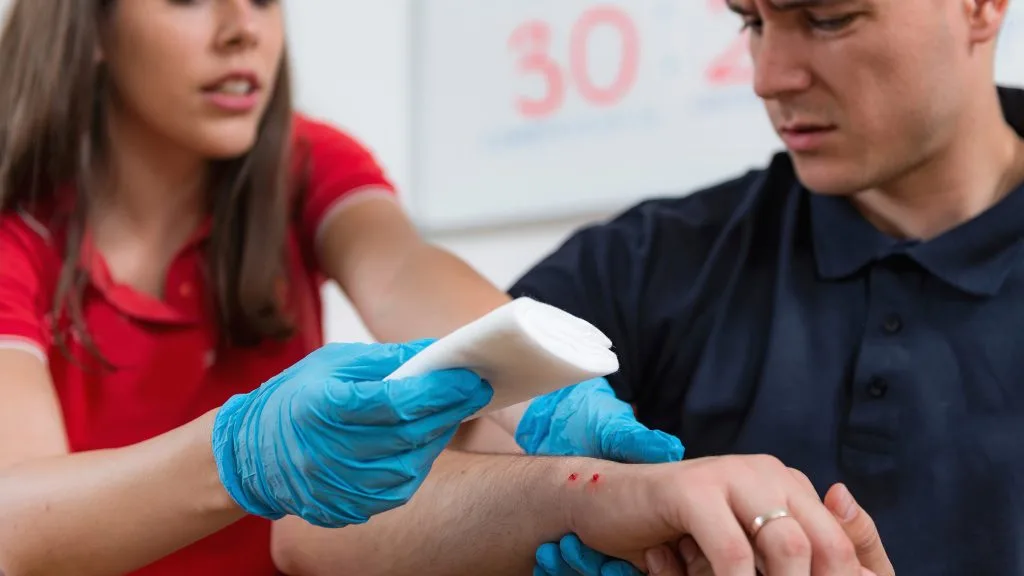
Cuts are common in workplaces that involve sharp tools, machinery, and material handling. Minor cuts should be cleaned with soap and water, treated with antibiotic ointment, and covered with a bandage. Deep cuts that expose underlying tissue, do not stop bleeding with direct pressure, or involve tendons or nerves require emergency medical care.
Burns
Thermal, chemical, and electrical burns occur in kitchens, laboratories, manufacturing plants, and other workplaces. Cool thermal burns with running water for at least 10 minutes. For chemical burns, flush with water for at least 20 minutes and remove contaminated clothing. Always refer to the Safety Data Sheet (SDS) for specific first aid instructions for chemical exposures.
Musculoskeletal Injuries
Back injuries, repetitive strain injuries, and overexertion are major sources of workplace disability. Proper lifting techniques, ergonomic workstations, regular breaks, and physical conditioning programs can significantly reduce these injuries.
Does your workplace meet first aid requirements? Canadian regulations require designated first aiders in every workplace. Our Standard First Aid and Emergency First Aid courses meet or exceed all provincial requirements. Register your team today →
Workplace Medical Emergencies
Cardiac Arrest
Sudden cardiac arrest can happen to anyone, anywhere, at any time. In the workplace, having employees trained in CPR and access to an automated external defibrillator (AED) can dramatically increase survival. For every minute that defibrillation is delayed, the chance of survival decreases by 7 to 10 percent. With an AED available and a trained responder, survival rates can exceed 70 percent.
Choking
Choking emergencies occur in office break rooms, restaurants, and cafeterias. Every employee should know how to recognize choking (the person may clutch their throat, be unable to speak, or turn blue) and how to perform abdominal thrusts. For a detailed guide, see our choking first aid article.
Allergic Reactions and Anaphylaxis
Workplace potlucks, insect stings during outdoor work, and latex exposure in healthcare settings can all trigger severe allergic reactions. Knowing how to recognize anaphylaxis and administer an epinephrine auto-injector can save a coworker’s life.
Seizures
If a coworker has a seizure, clear the area around them of any objects that could cause injury. Do not restrain them or put anything in their mouth. Time the seizure — if it lasts longer than five minutes, call 911. After the seizure, turn the person on their side and stay with them until they are fully alert.
Stocking Your Workplace First Aid Kit
Workplace first aid kits should be stocked according to the regulations of your province, territory, or state, as well as the specific hazards present in your workplace. At minimum, a workplace first aid kit should contain sterile gauze pads and rolls, adhesive bandages in various sizes, elastic bandages, medical tape, scissors and tweezers, antiseptic wipes, disposable gloves, a CPR barrier device, a triangular bandage for slings, an instant cold pack, a first aid manual, and an emergency blanket.
High-risk workplaces may require additional items such as burn dressings, eye wash stations, splints, tourniquets, and specialized equipment for chemical exposures. The first aid kit should be easily accessible, clearly marked, and inspected regularly to replace used or expired items.
Creating a Workplace Emergency Response Plan
Every workplace should have a written emergency response plan that includes the location of first aid kits, AEDs, and fire extinguishers, the names and locations of trained first aiders, procedures for calling emergency services (including the workplace address for 911 calls), evacuation routes and assembly points, procedures for specific emergencies such as fires, chemical spills, and active threats, and a system for reporting and documenting workplace injuries.
The plan should be reviewed and practised regularly. Emergency drills — including fire drills and first aid scenarios — help employees internalize the procedures so they can act quickly when a real emergency occurs.
The Business Case for First Aid Training
Beyond meeting legal requirements, investing in workplace first aid training delivers tangible business benefits. Trained employees respond more effectively to emergencies, reducing the severity of injuries and associated costs. First aid training improves workplace safety culture, as trained employees become more aware of hazards and more proactive about prevention. It also demonstrates to employees that their employer values their safety and wellbeing, which improves morale and retention.
Many insurance providers also offer reduced premiums to organizations with comprehensive first aid and safety programs. The cost of training is minimal compared to the potential cost of a serious workplace injury — including medical expenses, lost productivity, workers’ compensation claims, and potential legal liability.
Group Training with Coast2Coast
Coast2Coast First Aid offers group training packages for businesses of all sizes. Whether you need to certify a small office team or train an entire construction crew, our certified instructors deliver engaging, hands-on courses that meet all provincial and OSHA requirements. We offer Standard First Aid, Emergency First Aid, CPR and AED training, and specialized workplace courses.
With over 30 locations across Canada and the United States — including Toronto, Mississauga, Calgary, Edmonton, Los Angeles, and Halifax — we make it easy to get your team certified. Contact us to learn about group rates and on-site training options.
Register for CPR or First Aid Training
Register today for a CPR or First Aid training course at one of our 30+ locations across Canada and the U.S. Check out our facilities and book your spot now.
About the Author
Ashkon Pourheidary, B.Sc. (Hons) — Co-Founder, Coast2Coast First Aid & Aquatics
Ashkon has been a certified First Aid and CPR instructor since 2011 and an Instructor Trainer since 2013. He is also a certified Emergency Medical Responder (EMR) instructor, Psychological First Aid instructor, and BLS (Basic Life Support) instructor. Ashkon graduated with honours with a Bachelor of Science in Neuroscience from the University of Toronto in 2016. As co-founder of Coast2Coast First Aid & Aquatics, he has helped grow the organization to over 30 locations across Canada and into the United States. Ashkon has served on the First Aid Council for the Canadian Red Cross. He spends his time coaching the team of over 100 instructors at Coast2Coast to ensure that students training at Coast2Coast locations receive the best training experience. Connect on LinkedIn