
Quick Answer
Blended learning first aid training is the modern standard for first aid and CPR certification in Canada. Students complete interactive theory through online training at their own pace, then attend a shortened session led by a certified first aid instructor for hands-on skills practice. This hybrid model is fully WSIB-approved under Regulation 1101, meets 2026 CSA Z1210:24 standards, and the resulting Canadian Red Cross certificate is identical to one earned through traditional classroom learning — valid for three years nationwide.
In 2026, traditional two-day classroom sessions are increasingly difficult for busy professionals to schedule. The hybrid format combines structured digital theory with a focused in class training session to deliver complete first aid training without consuming an entire work week. Rather than spending 16 consecutive hours inside a training centre, students complete the heavy theory digitally — then arrive in the room ready to practise, not passively listen.
This approach has become the most popular pathway to earning basic first aid and CPR certification across Canada. At Coast2Coast First Aid & Aquatics, our blended courses span everything from Intermediate / Standard First Aid to Basic Life Support — ensuring every participant, from corporate managers to healthcare providers, meets national CSA Z1210:24 and provincial WSIB Regulation 1101 requirements.
How the Online Training Component Works: Self-Paced Theory
Your blended journey begins on the Canadian Red Cross online training portal. Within 24 hours of registration, you receive access to a theory module built around high-definition video, realistic case studies, and progressive knowledge checks — covering the clinical foundations of basic first aid before you touch a manikin.
The online training portion is entirely self-paced. You can pause and resume around your schedule, making it ideal for daycare staff, shift workers, and university students. Completing it unlocks the hands-on session; you will have covered all theory required before meeting your instructor in person. Core topic areas include:
- Emergency Medical System navigation — understanding response delays in dense urban settings.
- Medical Pathophysiology — recognising early warning signs of anaphylaxis, stroke (the FAST method), and diabetic emergencies.
- Trauma Protocols — theory behind severe bleeding control, tourniquet application, and spinal immobilization.
- Environmental Emergencies — managing Canadian-specific risks including hypothermia and frostbite.
Most participants finish the online training module in four to six hours for Intermediate / Standard First Aid, arriving at the in class portion with a solid grasp of the written examination requirements. For Emergency First Aid, the module typically takes two to three hours. The platform allows unlimited retakes on knowledge checks, provided you reach the required 80% threshold before advancing — ensuring you genuinely understand the same curriculum covered in any full in class training course.
The In Person Training Session: Converting Theory into Muscle Memory
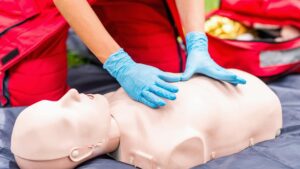
This session is where theory becomes lifesaving muscle memory. Because lectures are handled digitally, 100% of the time focuses on practical assessment. Under the direct guidance of a certified first aid instructor, you apply first aid skills hands-on — physically performing high quality CPR on manikins equipped with real-time feedback monitors.
This environment is where meaningful skill development takes shape. Monitors provide live data on compression depth (minimum 2 inches) and rate (100–120 bpm), ensuring every participant meets elite clinical standards. You will also master the deployment of an automated external defibrillator (AED) and the correct use of barrier devices — core components of basic first aid that prepare you for real emergencies. In 2026, hygiene protocols require one-way valve pocket masks for rescue breathing — all provided by Coast2Coast.
A key metric assessed here is Chest Compression Fraction (CCF) — the percentage of total resuscitation time spent actively performing chest compressions. Research consistently shows a higher CCF is directly linked to improved survival rates from cardiac arrest. This is a core focus of 2026 BLS training standards, and effective skill development depends on expert coaching to optimise CCF throughout every team dynamics drill.
Less in class training time vs. traditional format
Typical online training completion time
Minimum passing score on knowledge checks
Certificate validity — same as traditional format
Who Needs First Aid Training in the Canadian Workforce?
The blended format is the preferred choice for professionals who require readiness in basic first aid but cannot afford extended time away from work. To maintain compliance with WSIB Regulation 1101 and provincial OHS requirements, these roles benefit most from completing theory digitally before attending in person training:
- Security Guards & Property Managers — Often the first responders on-site; they require Intermediate / Standard First Aid and CPR Level C to maintain provincial licences. Blended learning lets them complete basic first aid theory online before attending in person.
- Teachers & ECE Staff — Legally required to hold emergency first aid certification and CPR Level C to manage pediatric emergencies including choking and anaphylaxis in real world scenarios.
- Construction & Industrial Workers — Can complete the digital module on rain days and attend the practical session on a convenient date, advancing basic first aid readiness without disrupting project timelines.
- Healthcare Providers & Medical Professionals — Nurses, dental staff, and emergency medical technicians require BLS certification covering team dynamics, oxygen administration, and medical emergencies as part of their ongoing first aid training.
- Health Care Students — Medical and nursing programmes require Basic Life Support as a curriculum prerequisite; digital modules fit demanding academic schedules, preparing students well before the practical session.
- Hospitality & Fitness Professionals — Personal trainers and hotel staff must be prepared to respond to individuals suffering sudden cardiac arrest in crowded venues, making basic first aid an essential professional obligation.
- First Responders — Police officers, paramedics, and firefighters benefit from BLS renewal formats that refresh single rescuer and team-based response without requiring full course repetition.
Blended vs. Traditional: Choosing the Right First Aid Training Format
Coast2Coast offers both learning formats across 30+ Canadian locations. The best choice depends on your learning style, schedule, and employer requirements.
Traditional All-In-Class Training is ideal for students who prefer full immersion. You have 100% face-to-face access to a first aid instructor for both theory and practice. This format suits individuals who prefer fully in-person delivery, or organisations booking private group sessions where an entire team benefits from being in the same room — building authentic team dynamics through every drill.
The Blended Advantage is all about time. Total in class training time is reduced by approximately 50%. For Intermediate / Standard First Aid, you complete the in class portion in a single efficient day instead of two. The platform also allows unlimited review of complex topics — such as the FAST stroke assessment or life threatening medical conditions protocols — before your final written examination, which takes place in person during that same session.
For healthcare professionals seeking a BLS renewal course, the blended pathway often includes a BLS renewal prerequisite challenge — a digital cognitive assessment confirming core BLS skills before advancing to the accelerated renewal format. Candidates must achieve a minimum score (typically 84%) to qualify for the shorter session rather than repeating the full-length BLS course.
⚠ Compliance Notice — 2026 Standards
All Coast2Coast first aid training courses are updated to reflect the 2026 CSA Z1210:24 standard and Heart & Stroke 2025 Guidelines for CPR and ECC. Your certificate meets WSIB Regulation 1101 requirements in Ontario and OHS requirements in Alberta. The issuing body (Canadian Red Cross) does not specify the delivery format on the certificate — it is treated identically by employers, regulators, and licensing bodies nationwide.
Certificate Validity, Recertification, and What Happens Next
A common question from employers is whether a blended certificate carries equal legal weight. In Canada, the answer is unambiguous: yes. The Canadian Red Cross credential does not state the delivery format. Whether you completed your first aid training in Toronto, Edmonton, or Halifax, it is a nationally recognised certificate valid for exactly three years — identical to any traditional classroom course.
Upon successful completion of both the practical and written components, your digital certificate is typically emailed within 24 to 48 hours. A digital wallet card is also provided immediately. Some organisations require a physical laminated card — your first aid instructor or the Coast2Coast team can arrange this on request.
As your card approaches expiry, we recommend our streamlined BLS recertification and recertification courses, also available in blended format. For health care professionals and health care students completing BLS certification online components, the renewal pathway follows the same structure — digital theory, hands-on skills session, completion card issued, BLS provider status renewed.
Companies managing large workforces can arrange private sessions: employees complete theory at their own pace, and a certified instructor travels to your facility for the group practical assessment — eliminating travel logistics and supporting consistent competency across your team.
Key Takeaway
Blended first aid training in Canada combines self-paced online training (4–6 hrs) with an in person training skills session — cutting total in class training time by 50%. A certified instructor leads all hands-on content, ensuring real skill development before certification. The resulting Canadian Red Cross certificate is legally identical to a traditional credential: WSIB-compliant, CSA Z1210:24-aligned, and valid for three years. It is the preferred pathway for healthcare providers, first responders, ECE staff, and construction workers who need high-performance certification without extended time away from work.
Register for a Blended First Aid Course Today
Join thousands of Canadians who trust Coast2Coast for WSIB-approved training. Get certified on your schedule at one of our 30+ locations across Canada.