


Reviewed by: Aryan Sekhavati, Director at Coast2Coast
The Quick Take: As of 2026, the three “essentials” for CPR training in Ontario have evolved. First, understand the transition to CSA Z1210:24 standards, where “Emergency” is now Basic First Aid. Second, master AED integration, which is now mandatory for construction sites. Third, focus on muscle memory—the ability to provide high-quality compressions within a 120-second response window.
Three Essential Things You Need to Know About First Aid and CPR Training
First aid and CPR training is one of those rare investments that can literally mean the difference between life and death. Whether you are a workplace manager responsible for employee safety, a parent concerned about your family’s wellbeing, or a young professional looking to enhance your resume, understanding the essentials of first aid and CPR training helps you make informed decisions about your education and preparedness.
The Canadian Red Cross has established comprehensive training standards that ensure every certified individual possesses the knowledge and skills needed to respond effectively in an emergency. Coast2Coast First Aid and Aquatics delivers these programs across more than 30 training locations throughout Canada, making quality first aid education accessible to communities from coast to coast.
Essential 1: Understanding the Different Certification Levels
The Canadian Red Cross offers a structured progression of first aid and CPR certifications, and choosing the right level is the foundation of effective training. Many people make the mistake of either under-certifying for their needs or paying for a more advanced course than their situation requires.
Emergency First Aid with CPR Level C is a one-day course that covers the core skills most people need. This includes adult, child, and infant CPR, AED use, choking management, wound care, and the recognition of common medical emergencies such as heart attacks, strokes, seizures, and diabetic emergencies. For most workplaces with low-to-moderate risk levels, Emergency First Aid satisfies the legal requirements under Ontario regulations.
Standard First Aid with CPR Level C is a two-day comprehensive course that builds on Emergency First Aid with additional modules covering head and spinal injuries, chest injuries, bone and joint fractures, poisoning and substance misuse, environmental emergencies such as hypothermia and heat stroke, and multiple-casualty incident management. This is the certification most commonly required by Ontario employers in industries with higher physical risk, including construction, manufacturing, mining, and outdoor recreation.
For healthcare professionals, the Basic Life Support (BLS) course provides clinical-grade resuscitation training including two-rescuer CPR, bag-valve-mask ventilation, and team-based emergency response scenarios. BLS certification is required by most hospitals, dental offices, physiotherapy clinics, and long-term care facilities across Ontario.
Essential 2: The Importance of Hands-On Practice
Reading about first aid techniques is useful, but it is no substitute for hands-on practice with professional instruction. The physical skills involved in CPR — achieving proper compression depth, maintaining the correct rate, delivering effective rescue breaths — require repetition and feedback from a qualified instructor to develop properly.
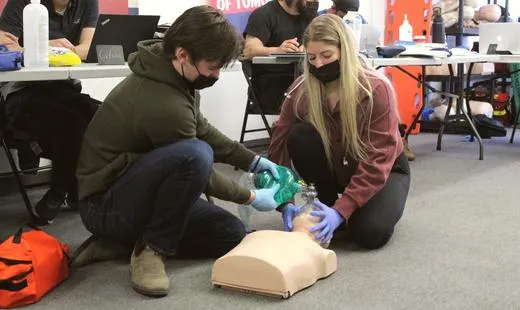
During a CPR training session, you practice on specially designed manikins that provide realistic resistance and allow your instructor to evaluate your technique. You will learn the correct hand placement, how to position your body to deliver effective compressions without exhausting yourself, and how to coordinate compressions with rescue breaths. These physical skills can only be developed through practice, which is why all Canadian Red Cross certifications require an in-person practical component.
AED training is another area where hands-on practice is essential. While AEDs are designed to be used by untrained bystanders, people who have practiced with a training AED respond significantly faster and more confidently in real emergencies. During your course, you will practice placing AED pads on a manikin, following voice prompts, and integrating AED use with ongoing CPR.
Essential 3: Keeping Your Certification Current
Earning your first aid and CPR certification is an important achievement, but maintaining it requires ongoing attention. Canadian Red Cross certifications are valid for three years, after which you must complete a recertification course to renew your credentials.
Recertification is not just a bureaucratic formality. Research shows that first aid and CPR skills deteriorate significantly over time without practice. Studies published in resuscitation journals have found that CPR skill retention begins to decline as early as three to six months after initial training. Recertification courses refresh your muscle memory, update you on any changes to treatment guidelines, and reinforce the decision-making skills needed to manage real emergencies.
One of the most common mistakes people make is allowing their certification to expire before registering for recertification. If your certification lapses, you will need to retake the full initial course rather than the shorter and less expensive recertification program. Coast2Coast recommends setting a reminder three months before your expiration date to ensure you have time to find a convenient course date.

Flexible Training Options for Busy Schedules
Coast2Coast understands that Toronto residents lead busy lives, which is why training is offered in multiple formats. Traditional in-person courses run on weekdays, weekends, and evenings at locations throughout the GTA. The blended online learning format allows you to complete theory at home before a shorter practical session. And private group training brings the instruction directly to your workplace.
Regardless of which format you choose, you receive the same high-quality instruction from certified Canadian Red Cross instructors and earn the same nationally recognized certification. The only difference is how the material is delivered, giving you the flexibility to choose the option that best fits your schedule and learning preferences.
Watch: First Aid and CPR Training Overview
Get Your First Aid and CPR Certification
Master the three essentials and build the skills that save lives. Register for a Canadian Red Cross certified course with Coast2Coast today.
Frequently Asked Questions
How do I know which certification level I need?
Check with your employer or professional licensing body first. Most Ontario workplaces require either Emergency First Aid or Standard First Aid with CPR Level C. Healthcare professionals typically need BLS. If unsure, Standard First Aid is the most versatile option as it satisfies the broadest range of requirements.
Can I challenge the exam without taking the course?
Canadian Red Cross certifications require attendance at an approved training course. You cannot simply write an exam to earn certification because the hands-on skills component is essential for competency evaluation.
What if I need to cancel or reschedule my course?
Coast2Coast offers flexible rescheduling policies. Contact the team as early as possible if you need to change your course date and they will work with you to find an alternative session at a convenient location.
About the Author
Ashkon Pourheidary, B.Sc. (Hons) — Co-Founder, Coast2Coast First Aid & Aquatics
Ashkon has been a certified First Aid and CPR instructor since 2011 and an Instructor Trainer since 2013. He is also a certified Emergency Medical Responder (EMR) instructor, Psychological First Aid instructor, and BLS (Basic Life Support) instructor. Ashkon graduated with honours with a Bachelor of Science in Neuroscience from the University of Toronto in 2016. As co-founder of Coast2Coast First Aid & Aquatics, he has helped grow the organization to over 30 locations across Canada and into the United States. Ashkon has served on the First Aid Council for the Canadian Red Cross. He spends his time coaching the team of over 100 instructors at Coast2Coast to ensure that students training at Coast2Coast locations receive the best training experience. Connect on LinkedIn