Free BLS, First Aid & CPR Course 2026 Guide to Get Certified for $0

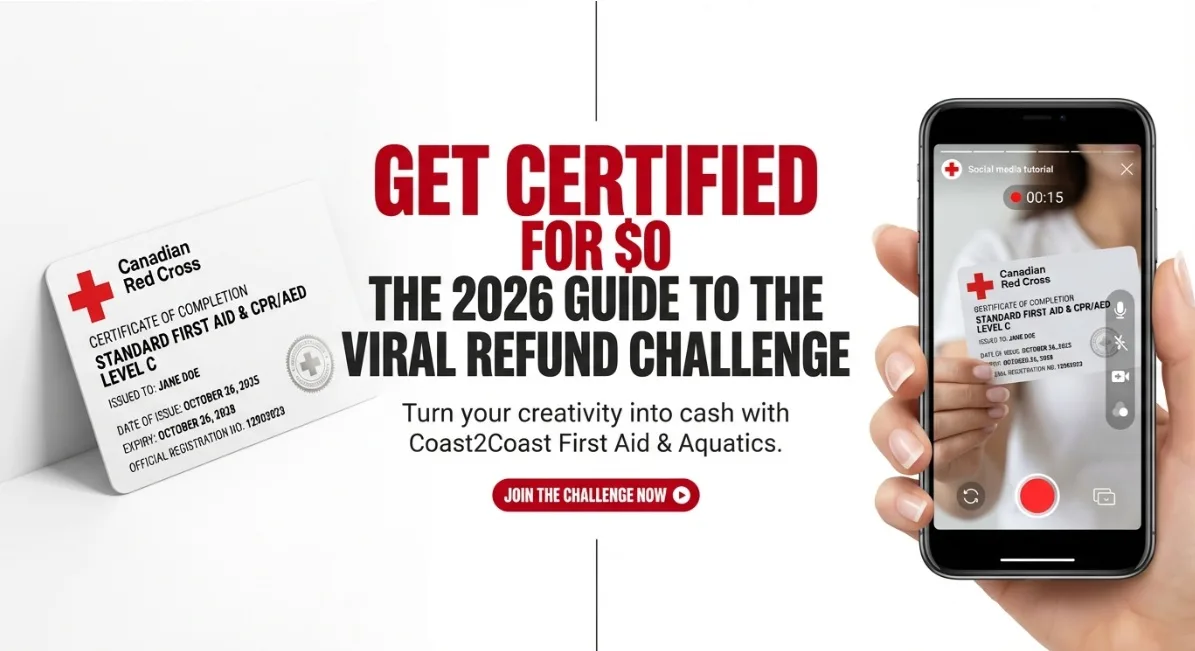
Student filming a selfie video during a free first aid and CPR course training session at Coast2Coast First Aid & Aquatics. - How to Get Your BLS, First Aid & CPR Course for Free: The "Go Viral" Challenge (2026 Guide)

Executive Summary: The Deal at a Glance

  • The Offer: Register for a course, film your experience, and post it online.

  • The Goal: Hit 5,000 views on Instagram OR 2,000 views on YouTube.

  • The Reward: A FULL REFUND of your course fee.

  • Eligible Courses: Standard First Aid, Emergency First Aid, CPR Level C, and Basic Life Support (BLS).

  • Locations: Toronto, Brampton, Ottawa, Calgary, Edmonton, and more.


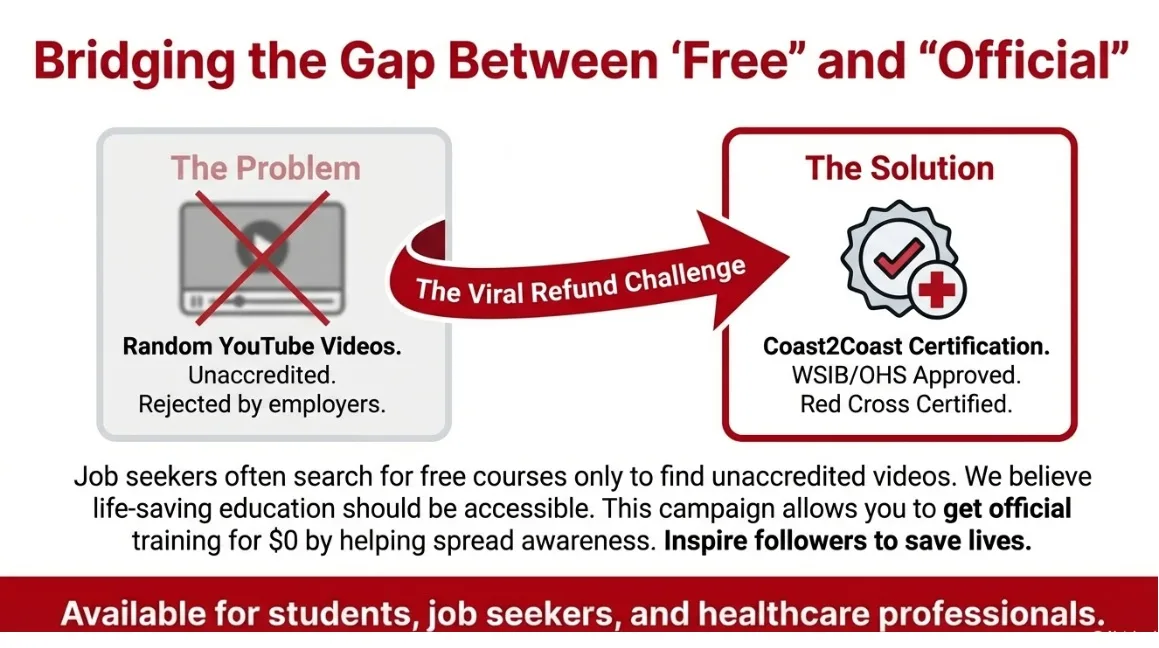
We know that for students, job seekers, and healthcare professionals, training costs can add up. You are constantly searching for a free first aid and cpr course or a free bls course near me, only to find that most “free” options online are just informational videos that don’t offer the official WSIB-approved certification you need to actually get hired.

At Coast2Coast First Aid & Aquatics, we believe life-saving education should be accessible to everyone. That is why we are launching our biggest student-creator campaign ever. We are giving you the chance to turn your creativity into cash—literally.

Here is your complete guide on how to get official Red Cross training for $0, plus everything you need to know about choosing the right course.

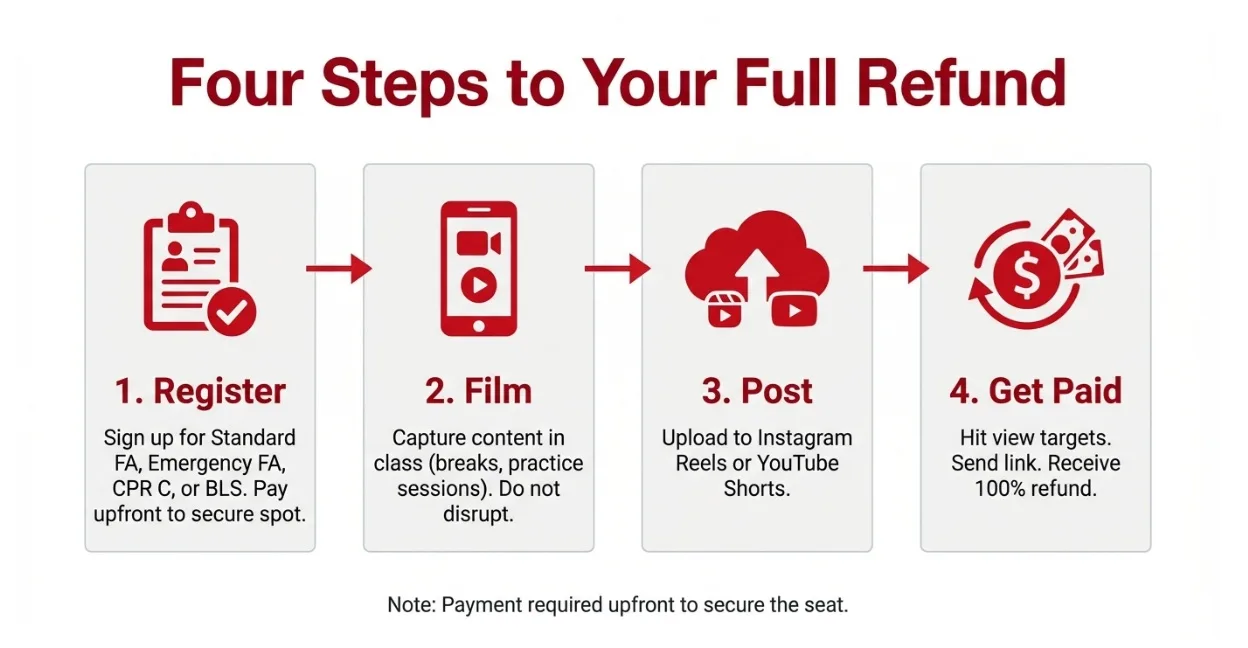
How It Works: 4 Steps to a Free Course

Free first aid courses Free first aid certification ontario Free first aid courses near me Free First Aid and CPR certification online Free First aid training Toronto Free first aid certification online Free First Aid certification in-person Free first aid and CPR training Toronto

You don’t need to be a professional influencer to qualify. You just need a smartphone and a little creativity during your training session.

1. Register for Your Course

Sign up for any of our eligible training sessions across Ontario or Alberta. You pay for the course upfront to secure your spot.

2. Film Your Experience

During your class (during break times or practice sessions, ensuring you don’t disrupt the class), capture content!

  • Film yourself practicing CPR on a mannequin.

  • Show off your bandaging skills.

  • Share a “Day in the Life” of getting certified.

3. Post & Tag Us

Upload your video to Instagram Reels or YouTube Shorts.

4. Hit the Views & Get Paid

If your video hits 5,000 Views on Instagram OR 2,000 Views on YouTube, send us the link! Once verified, we will issue a full refund to your original payment method.

Why Are We Doing This?

We want to spread awareness about the importance of CPR and First Aid. When you search for a first aid and cpr course free, you often find non-accredited videos that won’t help you get a job. We want to change that.

By sharing your journey, you aren’t just getting a free cpr course; you are inspiring your friends and followers to learn skills that save lives.

Wait, Which Course Do I Need? (The Ultimate Guide)

Before you sign up and start filming, you need to make sure you are taking the right course. Choosing the wrong certification is the most common mistake students make.

Here is a simple breakdown to help you pick the perfect training for your needs.

1. Standard First Aid & CPR/AED Level C

  • Best For: Construction workers, daycare staff, lifeguards, and general workplace compliance.

  • What It Covers: This is our most comprehensive course. It covers everything from spinal injuries and bone fractures to severe bleeding and CPR for adults, children, and infants.

  • Validity: 3 Years.

2. Emergency First Aid & CPR/AED Level C

  • Best For: Security guards, fitness instructors, government employees, or those needing a basic overview.

  • What It Covers: A shorter, 1-day course focusing on immediate life-saving interventions like choking, CPR, and using an AED.

  • Validity: 3 Years.

3. Basic Life Support (BLS)

  • Best For: Healthcare professionals (Nurses, Dentists, Paramedics, Firefighters).

  • What It Covers: This is a high-intensity, fast-paced course that focuses on high-performance CPR, trauma response, and team dynamics in a clinical setting.

  • Validity: 1 Year (Annual renewal is required).

The “Blended Learning” Advantage

If you are looking for an online cpr course free of classroom time, “Blended Learning” is the closest you can get while still remaining certified.

How It Works:

  1. Online Theory: You complete the “textbook” portion of the course online, at your own pace, from the comfort of your home.

  2. In-Class Skills: You attend a shorter, focused in-person session to practice hands-on skills.

Why Students Love It:

  • Flexible: Study late at night or on weekends.

  • Efficient: Cut your classroom time in half.

  • WSIB & OHS Approved: Yes, it is fully recognized by employers in Ontario and Alberta.

Tips to Go Viral (and Get Your Refund)

Want to hit those 5,000 views fast to secure your refund? Here are some content ideas that perform well on social media:

  • The “Stayin’ Alive” Challenge: Perform CPR compressions to the beat of the famous Bee Gees song.

  • Nursing Student Vlogs: Show the reality of your BLS course online free study session vs. the intense in-class practical training.

  • “Did You Know?”: Share a surprising fact you learned from your Coast2Coast instructor (e.g., “I bet you didn’t know this about using an AED…”).

  • Local Vibes: Tag your location! Whether it’s First Aid in Vaughan, CPR in London, or Training in Mississauga, local content trends faster.

Frequently Asked Questions (FAQ)

We know you have questions. Here are the answers to the most common queries about our courses and the refund offer.

About the “Free Course” Offer

1. Is this really a free first aid and cpr course with certificate? Yes! You pay upfront to reserve your seat and receive your official Canadian Red Cross certificate. However, if you meet the social media view requirements, we refund 100% of your fee, effectively making it a free cpr course with certificate.

2. Can I find a free bls course near me? Official BLS (Basic Life Support) training usually requires payment because it is a professional-level certification. However, our campaign applies to BLS courses too! If you are a nursing student looking for a free bls course, this challenge is your best route to getting certified for free.

3. Does this apply to the online cpr course free portion? Our courses are “Blended Learning,” meaning you do half online and half in-class. The refund covers the entire cost of the training, including the online access and the in-person workshop.

4. I am looking for a free cpr refresher course. Does this count? Absolutely. Whether it is a full certification or a cpr refresher course online free of charge (via refund), the challenge applies as long as you are registered in a Coast2Coast session.

5. Is this available in my city? This offer is valid at all Coast2Coast locations. So whether you are searching for a free cpr course Toronto, free cpr course Ottawa, free cpr course Calgary, or a free cpr course Belleville, you are eligible to participate!

About Certification & Validity

6. Is the certificate WSIB approved? Yes. Unlike many generic online free cpr course options you find on the web, our training is fully WSIB (Ontario) and OHS (Alberta) approved.

7. How long is my First Aid certificate valid? For Standard and Emergency First Aid, your certificate is valid for 3 years. If you take Basic Life Support (BLS), you must renew it every 1 year.

8. Can I recertify instead of taking the full course? Yes! If your current Standard First Aid certificate has not expired yet, you can take a shorter Recertification Course. This saves you time and money.

9. Can I do the cpr course online free without attending class? No. To get the official certificate, you must attend the in-class skills session. Purely online courses are rarely accepted by employers in Canada.

10. What if I lose my certificate? All Canadian Red Cross certificates are digital. You can access your profile online at any time to download a new copy for free.

Logistics & Details

11. Do I need to bring my own equipment? No. We provide all mannequins, AED trainers, and first aid supplies.

12. Can I get a free cpr course with certificate if I am not a student? Yes! This offer is open to everyone—students, parents, teachers, and professionals.

13. What if I am taking the course for a group? The refund applies to the individual who posts the content. If you book for a group, each person can post their own video to try and earn their own refund.

14. Does the bls course free offer include the manual? The digital eBook is included in your course registration.

15. How long does the refund take? Once you email us your video link and we verify the views, the refund is typically processed within 5-10 business days.

16. Can I combine this with other promo codes? Since the reward is a full refund, it cannot be combined with other discounts. You are getting the whole course for free!

17. What hashtags should I use to help it go viral? We recommend using local tags like #TorontoLife, #CalgaryViews, or #StudentLife alongside our official tag #Coast2CoastFirstAid.

18. Where do I send my video link? Send your booking ID and the link to your viral video to our marketing team email (listed on our contact page) with the subject line “Go Viral Refund Claim.”

19. What if I don’t hit the view count? You still walk away with a valuable, federally recognized certification that boosts your resume. You have nothing to lose!

20. Can I post on TikTok instead? Currently, our tracking is set up for Instagram Reels and YouTube Shorts as they allow for the best reach verification. However, feel free to cross-post to TikTok for extra exposure!

Ready to Go Viral?

Don’t settle for an unaccredited online free cpr course that your employer won’t accept. Get the Gold Standard of Red Cross training, have fun filming it, and let us foot the bill.

Find Your Course & Register Now

(Terms and conditions apply. Views must be organic. Offer valid for a limited time.)

Breast Cancer Awareness

A group of thirteen people, diverse in appearance, smiling and posing indoors. One person on the left holds a small white dog. Behind them are posters about training and safety.

Stay informed this Breast Cancer Awareness Month. Learn about early detection, current screening guidelines in Canada, practical steps if you find a lump, how to talk to your doctor, and ways to support loved ones facing breast cancer.

Continue reading

10 Essential Items For A First Aid Box Kit

Person holding a first aid kit.

The choice of tools for your first aid kit is important if you want to be prepared for any emergency involving minor injuries like abrasions, burns, stings, or cuts. Every home should have a first aid kit, but you should also make sure to have one in your car. Additionally, if you and your family enjoy the outdoors you should always have a minimum of a basic first aid kit on hand.

Continue reading

First Aid and CPR Training for Dental Professionals

A dentist treating her patient in a clinic.

While your expertise lies in the intricacies of dental care, have you ever paused to consider the critical role that First and CPR knowledge and skills play in ensuring the well-being of your patients and staff? Dental offices, like any healthcare setting, are not immune to unexpected medical emergencies. From minor incidents like fainting to life-threatening events like cardiac arrest, the ability to respond swiftly and effectively can make all the difference. First Aid and CPR training for dental professionals in a clinic could help enhance efficiency, safeguard well-being and improve the overall reputation of the clinic.

Continue reading

Essential First Aid and CPR Training for PSW

Essential First Aid and CPR Training for PSW

Being a Personal Support Worker (PSW) requires you to play a very significant role in the lives of people who rely on you on a daily basis. It requires being prepared for the unexpected, which proves your dedication to improve their quality of life to support them. First Aid and CPR training are not only essential tools for PSWs but are also required for employment.

Continue reading

Is Swimming Hard to Learn? Tips & Safety Advice

A swimmer wearing a swim cap and goggles adjusts her gear while standing in a pool. The water level is midway up her body, and she appears to be focused. The background shows a clear blue sky and some buildings in the distance.

According to the WHO, drownings account for 7% of all injury-related deaths, making it the 3rd leading cause of unintentional injury death globally. Therefore, swimming is more than just a way to keep fit or for enjoyment, it is an essential skill. Learning swimming is crucial for safety and fitness. But is swimming hard to learn?

Swimming is an easier skill to learn for people with exposure to water, making it more difficult for people without aquatic exposure to master. A fear of water is one of the main reasons many people don’t learn how to swim, but it is not a difficult skill to learn. Moreover, children can learn to swim from a very young age.

Best way to learn to swim

The best way to learn to swim properly is to join swim lessons, such as a beginner’s swimming class or private swimming lessons. Besides your swimming lessons, it is also a good idea to get lots of practice, allowing you to perfect your strokes and breathing techniques. Practicing holding your breath underwater is a crucial exercise in swim lessons. When learning to swim, you need a sense of calm and to avoid fighting with the water. Remember, it is important to have someone there to assist you if necessary when you are learning how to swim. Do not swim alone.

With children, the best time for them to start learning is around the age of 1. They are taught the basic survival skill of floating first, and then how to build their confidence around the water. Thereafter, they start learning other swimming elements. Children are fast learners.

A swimmer wearing goggles and a swim cap performs a freestyle stroke in a swimming pool. The pool is divided into lanes with blue, white, and red lane dividers. The water is clear, and the swimmer is in the middle of a stroke with one arm extended forward.

Register for Mobile Swimming Lessons

At Coast2Coast, we provide Mobile Swimming lessons in the Greater Toronto Area! Inquire about our Mobile Swimming program today and gain confidence in your swimming skills.

How long will it take to learn to swim?

Usually, for kids, learning to execute a good swimming style and completing laps requires 15 to 30 hours of swimming instruction. For adults, the learning process to reach the same level can take anywhere between 20 to 40 hours. Of course, these times may vary, depending on any previous experience and the type of instruction you are receiving.

It may take a few weeks of consistent practice to master swimming techniques. The more you practice, and the faster you overcome your fear of the water, the quicker it is to master swimming. Then, there are different levels of expertise, from competitive swimmer to professional swimmer.

Why is swimming more difficult for some people to master?

The popularity of swimming is undeniable, and we all envy the swimmers, like Michael Phelps, we watch at events like the Olympics or swimming competitions. Swimming has unique challenges compared to other sports due to its specific physical demands, such as restricted breathing and the horizontal position of the body. It is more than just a pleasurable sport to watch, but has plenty of health benefits.

It can feel like quite a feat to learn how to swim if you fear the water or haven’t mastered the art of staying afloat. One of the greatest forms of anxiety that could hold you back from learning is the fear of drowning.

A baby in a pink swimsuit is held up in a swimming pool by an older woman with gray hair and a black-and-white striped swimsuit. A younger woman with brown hair smiles in the water next to them, all enjoying the sunny day.

Challenges beginners need to overcome when learning to swim

There are several challenges you will need to overcome as a beginner:

  • Anxiety

If you are tense and anxious, then it becomes very difficult to learn to swim. Anxiety leads to harsh movements that don’t allow the body to glide through the water, leading to it being dragged down. Practice your movements and keep them streamlined to help you glide through the water.

  • Breathing

Learning to breathe properly is the most challenging swimming technique. You need to practice syncing your breath with your strike and exhaling through your nose underwater. Swimmers breathe differently compared to land-based sports, which can add to the difficulty. This takes practice, but it’s not impossible to learn.

  • Coordination

Pulling and kicking are techniques that work in combination to create the perfect stroke when you swim but as a beginner, these are often difficult to coordinate. Practice by breaking down the stroke, and learning it over shorter distances until you get the timing and execution right. Focusing on one skill at a time can help you progress faster.

  • Overthinking the technical elements

The combination of elements that give you propulsion requires smooth execution so your body can glide in the water. If you are overthinking all these techniques, you will fall into an unnatural rhythm that can look mechanical. Practice all the technical elements, such as front crawl or butterfly stroke, until they become second nature. Mastering one stroke can make it easier to learn other strokes.

An elderly woman helps a young girl loose fear of the water while two children, dressed in swimwear with goggles and swim caps, stand nearby. They are indoors with large windows showing a cityscape in the background.

Swimming Lessons for All Ages!

It’s never too late to learn how to swim. If you have access to a pool, we can teach you! Contact us today to set up your mobile swimming lessons.

The Road to Become a Proficient Swimmer

The swimming learning process is essential for developing a strong swimmer, especially for older children interested in competitive swimming. Typically, this journey begins in a pool, where the first five lessons focus on foundational skills. During these initial sessions, a good coach emphasizes safety and comfort in deep water, gradually introducing techniques that make swimming efficient and enjoyable. In just two weeks, children can progress significantly, learning to float, kick, and perform basic strokes. As they master these skills, the next point in their learning process at the pool is building endurance and refining technique. Through regular practice, they develop confidence and strength, paving the way for more advanced swimming techniques. The combination of structured lessons, consistent feedback from a coach, and supportive practice creates an effective learning environment. This foundation not only prepares them for competition but also instills a lifelong love for the water. Ultimately, the swimming learning process transforms beginners into proficient swimmers, ready to tackle more challenging aspects of the sport while ensuring they are safe and confident in their abilities.

Where to learn to swim?

If you live in Ontario, our swim school at Coast2Coast is a great place to learn how to swim regardless of age or skill level. Swimming engages the upper body muscles, providing a full-body workout. We offer a wonderful Mobile Swimming program for those who have their own pool. Mobile Swimming makes it easy for students to learn basic or advanced swimming laps. Simply choose a date and time and we will send one of our experienced instructors to your home, community centre or local YMCA.

You may choose a private, semi-private or group swimming lesson. This makes it easy for you or a small group to learn how to swim. Our lessons are adaptable for either adult learners or new swimmers. Registration is simple and may be achieved by calling our toll-free number: 866-291-9121.

Final Word

Learning to swim is one of the most important survival skills you can acquire. It not only empowers you to stay safe in and around water but also opens up a world of recreational opportunities. Swimming is a low-impact and aerobic sport, making it accessible for individuals of all ages and fitness levels. Whether you’re a child eager to dive in or an adult who has always wanted to learn, it is never too late to start!

To enhance your learning experience, consider enrolling in lessons with a qualified instructor who emphasizes safety and proper technique. Remember to practice in a controlled environment, like a pool, where you can build confidence and skills gradually. Safety should always be your top priority—never swim alone, and always be aware of your surroundings. Additionally, practicing relaxation techniques can help ease anxiety in the water. Embrace the journey of learning to swim; not only will you improve your physical fitness, but you will also gain a sense of accomplishment that lasts a lifetime.

A smiling child wearing a green swim cap and pink goggles rests on the edge of a swimming pool. The water is a bright blue, and the child appears to be in a swimsuit, enjoying their swimming lesson in the pool.

Practice Swimming Skills With a Certified Instructor

Whether you’re a beginner, intermediate or an expert, our swimming instructors are here to help you! Practice any of your swimming skills with a trained swimming instructor. Our swimming programs are tailored to YOU!

What is EMR (Emergency Medical Responder) Course?

Three people are securing a person on a stretcher with orange straps. The person on the stretcher is lying down with a neck brace. A table with medical equipment is in the background. All individuals are wearing masks.

What is EMR (Emergency Medical Responder) Course?

At Coast2Coast, we believe that providing immediate life-saving care to critical patients requires in-depth knowledge and skills. Upon completion of our Emergency Medical Responders (EMR) Course, certificate holders are trained to provide basic life-saving interventions in any type of emergency.

First Responders are usually the first line of help to arrive at the scene of an emergency. They have minimal equipment at their disposal but can perform their life-saving skills as they wait for additional resources to arrive. Once completed with their training, Emergency Medical Responders are also capable of assisting higher-level personnel during patient transportation.

EMR Training Course

Learning to care for patients as a first responder requires the proper training. This is easy to do when you register for EMR training at Coast2Coast.

The Course

Successful candidates, who pass every section of the course, receive the Canadian Red Cross certification. The certificate is valid for 3 years. At Coast2Coast, our dedicated instructors have put together high-quality programs that follow the Canadian Red Cross guidelines and are based on years of experience. Our course and topics cover all types of life-saving skills that emergency medical responders may face during any type of emergency, including in a marine environment.

State-of-the-art equipment is used for all EMR training, and once the course is completed, everyone is well-versed in how to use everything. The field of emergency care is ever-evolving, and we feel it is vital that skills are learned by using the latest available technology. This ensures that the heroes who respond to emergencies in their communities are equipped to meet any situation head-on.

Register for EMR Training

Coast2Coast offers Pre-Hospital Care courses and training to First Responders, and those providing care in a pre-hospital setting. All of our training is based on the Canadian Red Cross guidelines. 

The course covers a variety of topics to ensure the ability to deal with any unexpected situations during emergencies. These include basic topics like circulation, breathing emergencies, and the prevention of disease transmission during any emergency. The instruction also includes advanced situations like sudden medical emergencies and how to deal with head and spine injuries.

Understanding workplace legislation and responsibilities are also important, and the course offers detailed instruction on these topics.

Here’s a video we made that summarizes the essentials students will review in the Emergency First Aid & CPR/AED Level C course.


Course Duration

As the highest level of First Aid and CPR/AED training, the Emergency Medical Responder course is intensive. The eight-day course takes 80 hours to complete and prepares first responder participants in both theoretical and practical training. Training is typically held over a two-week period. Occasionally, courses will run over four weekends for those who cannot attend during weekdays.

Other Important Course Topics

Lifesaving and patient assessment skills require hours of practice and during the course, many different scenarios are covered. This ensures the students are ready to care for patients as first responders.

During the 80-hour course, the participants learn anatomy and physiology, circulatory emergencies, airway management, and respiratory emergencies. Other important topics covered include threatening hemorrhages and soft tissue trauma, shock, choking, all types of musculoskeletal injuries, acute and chronic illnesses, pregnancy emergencies (including labour),  and crisis intervention. Pharmacology, transportation, dealing with multi-casualty emergencies, and reaching and extricating patients are also taught. This is an intense and complete course that covers the needs of every person wanting to work as a first responder.

What Types of Training Courses are Available?

Once the basic First Responder training is completed, some responders choose to do an Emergency Medical Responder Upgrade course. The upgrade course provides Emergency Medical Responders another 40-hours of theoretical learning and hands-on training.

For those who need EMR training recertification, there is a 4-day training course. Recertification is important because responders get to learn the latest techniques and how to use the latest technology. Not only do they learn the latest techniques, but they also get time to practice skills they may not be as familiar with.

At Coast2Coast, groups of eight participants or more also have the option of booking a private training course. This can either be held at one of our facilities, or an experienced instructor can come to your location.

Register for First Aid Training

Register today for a First Aid training course and learn how to deal with emergencies and keep your loved ones safe! Check out our facilities and book your spot now.