
A CPR Certification Does Not Mean Workplace Emergency Ready. New Study on Examination Data Shows What’s Missing Can Be Very Costly.
An analysis of 20,000+ Canadian first aid exams finds the worst knowledge gap is in bone, muscle, and joint injuries, the leading driver of workplace injury costs and the one major emergency CPR training never covers. In Coast2Coast’s dataset, bone, muscle, and joint injuries produced the highest wrong-answer rate at 27.7%, the same category behind 38% of all Ontario WSIB claims. CPR itself had the lowest wrong-answer rate at 8.6%. The fix is Intermediate First Aid (formerly Standard First Aid), now one working day of in-class time. The case for requiring it is no longer close.
Walk into almost any Canadian workplace and ask who is trained to handle an emergency, and the answer is usually the person holding a CPR certificate: the personal trainer on the gym floor, the coach on the sideline, the office manager who took the company-sponsored course. That certificate carries an implicit promise to everyone around them: this person knows what to do. A new analysis of more than 20,000 written first aid exams, drawn from the training network of Coast2Coast First Aid, shows that the promise holds for exactly one kind of emergency, cardiac arrest, and breaks down for nearly every other.
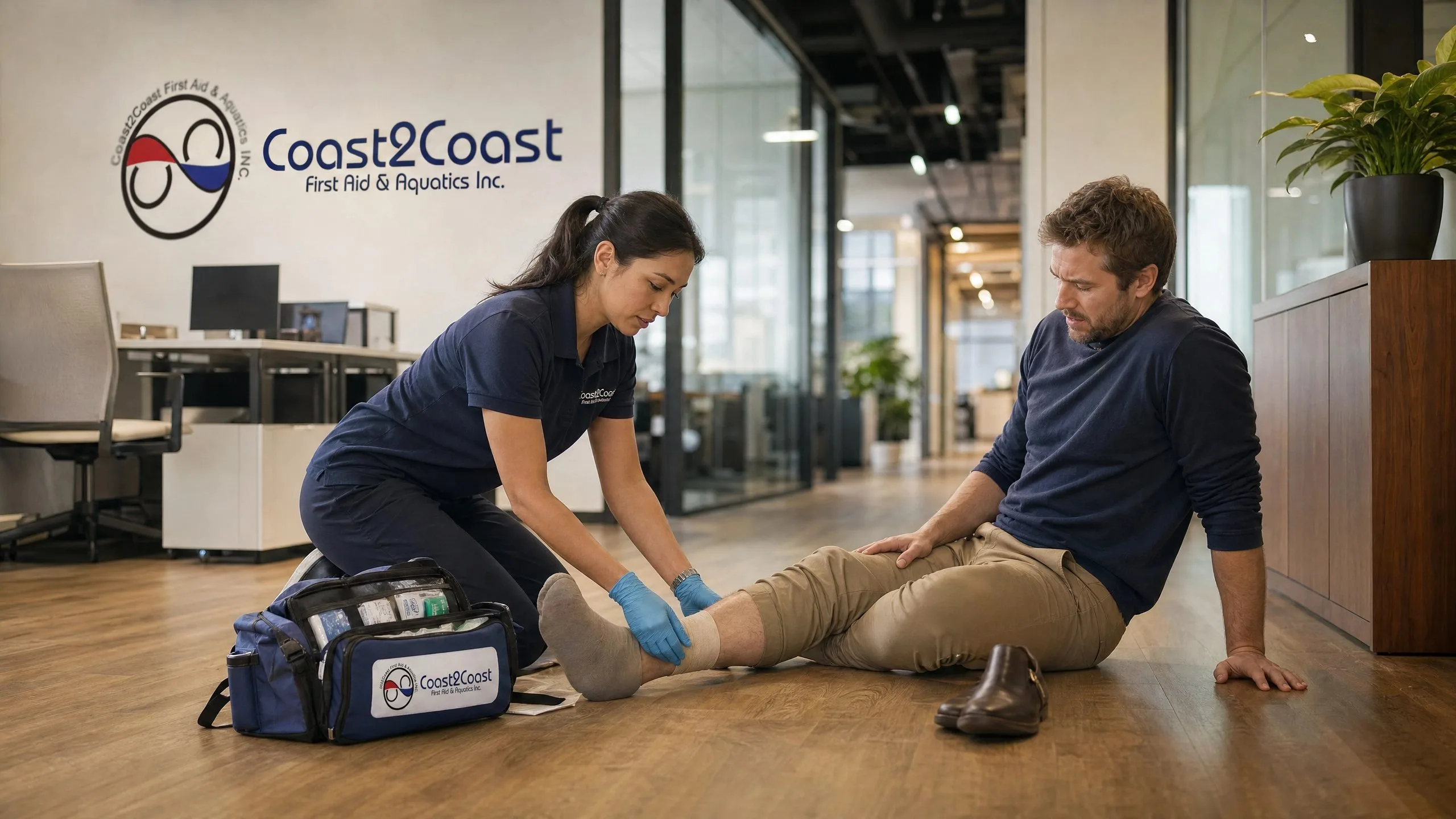
“CPR training is essential, and we teach it every day. But a CPR course is a cardiac arrest course. It was never designed to handle a broken bone, a torn muscle, or a bad fall. A personal trainer whose client tears a shoulder, a parks worker responding to a child who fell from a climbing frame, an office manager whose colleague goes down with a serious sprain: none of them were trained for that moment. Our data proves the gap is real and measurable. Intermediate First Aid closes it in one working day. There is no longer a good reason to treat a CPR card as enough.”
Ashkon Pourheidary, Founder, Coast2Coast First Aid, Canadian Red Cross Instructor Trainer
The Data
This analysis was made possible by a tool that did not previously exist in the first aid industry. Coast2Coast built the first in-classroom digital testing platform among first aid providers in North America. For decades, the written exam at the end of a first aid course was graded on paper, the score was recorded, and the paper was filed away for audit purposes. The reason is simple: there was no way to look across thousands of students and ask which topics they struggled with, no feedback loop between how students actually performed and how the course was taught, and no dataset that could inform policy. Every provider was flying blind on the one question that matters most: do the people we certify actually know this material?
The platform changes that. It captures every individual response a student submits, not merely whether they passed, and tags each question to a knowledge area by the content it tests, so performance can be aggregated across the entire network by question, topic, course, and cohort. The distinction matters more than it sounds. A student can pass a first aid exam overall while answering an entire category of questions incorrectly, and under the old paper-graded system that pattern was invisible. At scale it becomes clear which topics consistently challenge students and whether the gaps cluster in predictable places. They do. The dataset behind this release covers 539,821 individual question responses from more than 20,000 students, collected between July 2025 and May 2026 across 381 distinct question-course administrations (after excluding two malformed questions), to the company’s knowledge the largest body of first aid knowledge-performance data ever assembled and published by a training provider in North America.
Wrong-Answer Rates Across Five Knowledge Areas
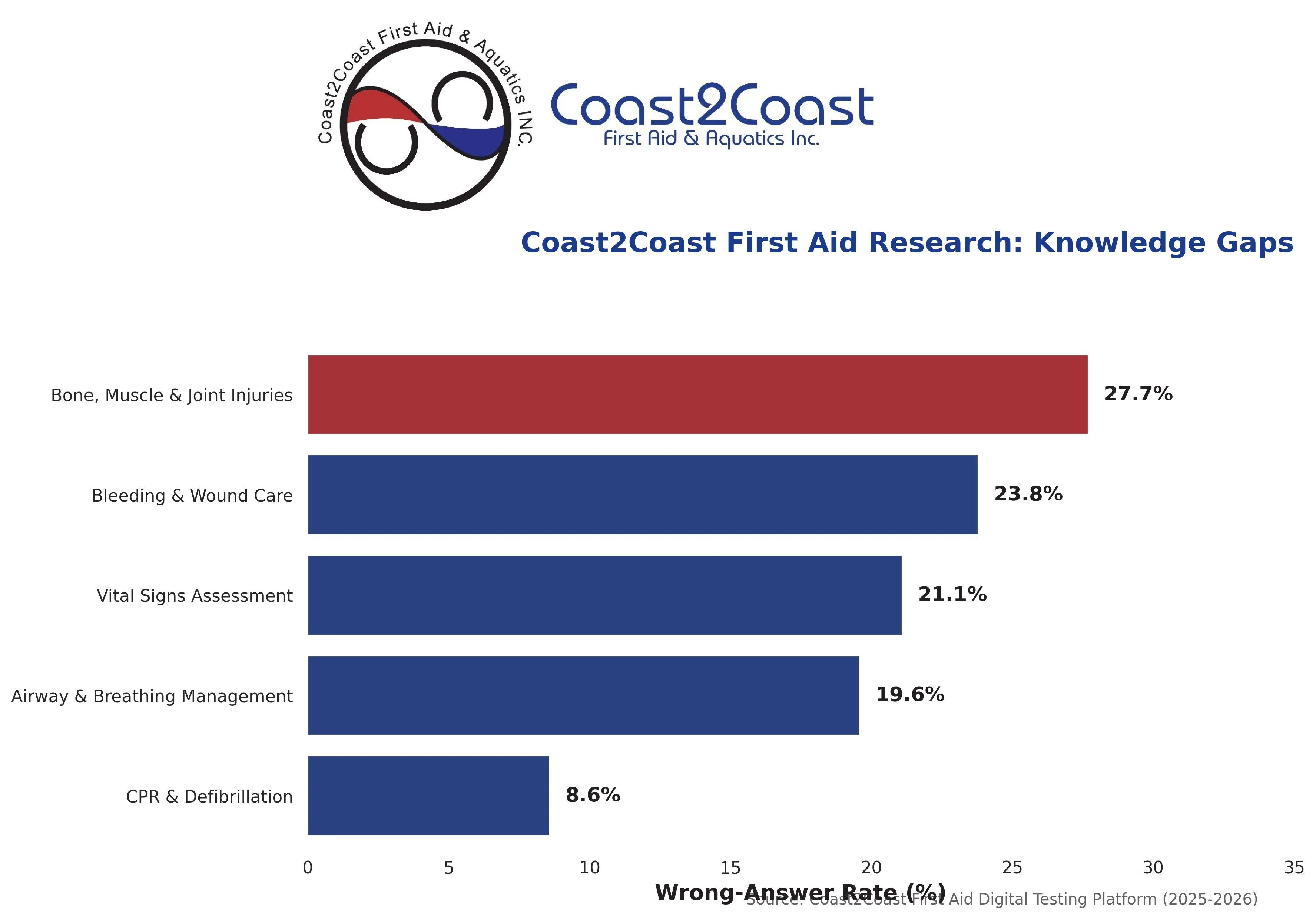
Wrong-answer rates by knowledge area, drawn from the Intermediate First Aid (formerly Standard First Aid) cohort, the most comprehensive certification and the most widely administered exam in the network, are shown below. Rates are attempt-weighted averages across all questions in each category, so no single unusually hard question can distort a category; the bleeding and wound care figure, for example, is averaged across more than 30,000 attempts spanning multiple distinct questions.
| Knowledge Area | Wrong-Answer Rate | Total Attempts |
|---|---|---|
| Bone, muscle & joint injuries | 27.7% | 13,684 |
| Bleeding & wound care | 23.8% | 30,755 |
| Vital signs assessment | 21.1% | 15,621 |
| Airway & breathing management | 19.6% | 79,763 |
| CPR & defibrillation | 8.6% | 53,534 |
Source: Coast2Coast First Aid digital testing platform, July 2025 to May 2026. 20,000+ students, 381 question-course administrations.
The pattern is the opposite of what most people would predict. CPR, the skill that dominates public attention and workplace training, has the lowest wrong-answer rate in the dataset. Bone, muscle, and joint injuries, the category most likely to arise in an actual workplace, has the highest. Two individual questions sharpen the point:
- “When should you apply a sling or splint for a bone, muscle, or joint injury?” Answered incorrectly by 33.6% of respondents (8,279 attempts).
- “What should you do if the dressing on a penetrating chest wound becomes saturated?” Answered incorrectly by 44.1% of respondents (8,279 attempts).
What These Numbers Mean in Practice
These are foundational decisions, not clinical edge cases. Knowing when to immobilize a suspected fracture, and what to do when a dressing fails to control bleeding, is the kind of thing a designated workplace responder is expected to handle on an ordinary day. And the workers who missed them had just completed the comprehensive course. They sat through the instruction, practised the skills, and wrote the exam. The knowledge simply did not consolidate for a meaningful share of them.
There is an important implication buried in that fact. These wrong-answer rates were recorded on the day of certification, immediately after training, not three years later at renewal. A 27.7% miss rate at the moment of certification is not a memory-decay problem. It is an acquisition problem: the content was delivered but not absorbed by more than a quarter of students on first exposure. That is a learning-design challenge worth taking seriously, and it is one reason measuring knowledge, rather than assuming it from a certificate, matters so much.
If the gap is this wide among Intermediate First Aid graduates, who were actually taught this material, it is necessarily wider among the far larger population whose only credential is CPR, where bone, muscle, and joint injury content was never on the syllabus at all. That is the population this report is most concerned with.
What CPR Training Covers, and What It Does Not
Canadian CPR/AED certification comes in two common workplace levels. CPR Level A covers cardiac arrest, AED use, and choking for adults. CPR Level C extends the same skills to children and infants and adds management of major life-threatening bleeding, including tourniquet use. Level C runs roughly three to four hours and is the more common of the two.
Both levels are built around a single category of emergency: the failure of breathing or circulation. Chest compressions, rescue breaths, AED deployment, choking response, control of catastrophic bleeding. These are time-critical events where immediate action saves lives, and CPR training prepares workers for them well, which is exactly why CPR is the lowest wrong-answer category in the data.
What CPR training does not address is almost everything else a workplace responder will actually encounter. Bone, muscle, and joint injuries: fractures, sprains, strains, dislocations. Head, neck, and spinal injury assessment. Wound care beyond catastrophic bleeding. Burns. Poisoning. Seizures, strokes, diabetic emergencies, and severe allergic reactions. The structured head-to-toe secondary assessment that helps a responder identify an injury that is not immediately obvious. That entire range belongs to Intermediate First Aid (formerly Standard First Aid), the comprehensive Canadian Red Cross certification that meets the CSA Z1210 national standard.
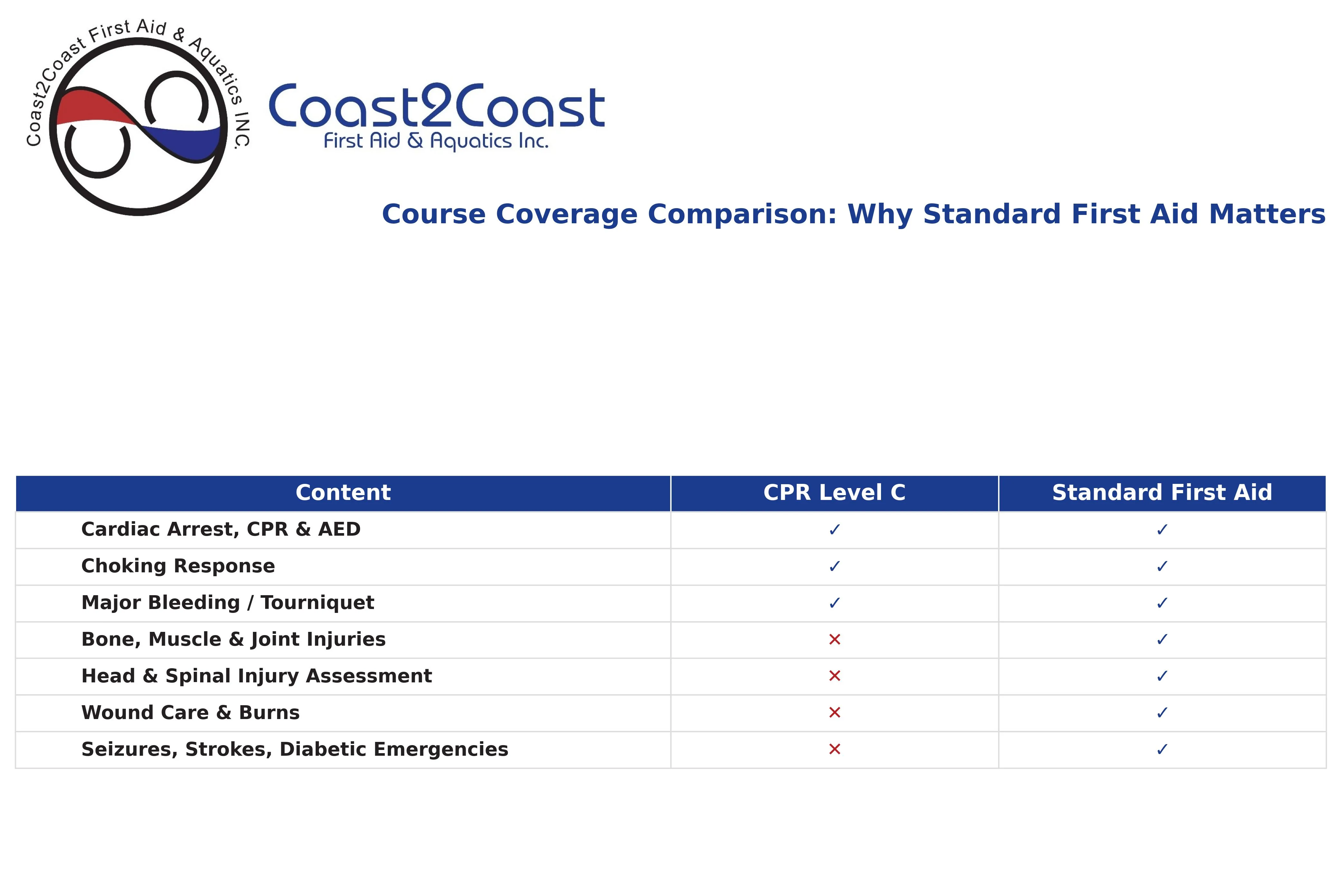
None of this is a knock on CPR training. The issue is not that it is weak. It is that it is narrow by design. It was built for the emergencies where seconds determine survival, and it does that job well. It was simply never built to be a general workplace first aid credential, and the data shows what happens when it is treated as one. The contrast is clearest side by side:
| Content | CPR/AED Level C Blended | Intermediate First Aid CPR/AED Level C Blended |
|---|---|---|
| Cardiac arrest, CPR & AED | ✓ | ✓ |
| Choking response | ✓ | ✓ |
| Major bleeding / tourniquet | ✓ | ✓ |
| Bone, muscle & joint injuries | ✗ | ✓ |
| Head & spinal injury assessment | ✗ | ✓ |
| Wound care & burns | ✗ | ✓ |
| Seizures, strokes, diabetic emergencies | ✗ | ✓ |
| Approx. in-class time | 4 hrs | 8 hrs (one day) |
Sources: Canadian Red Cross course descriptions; CSA Z1210. Intermediate First Aid is blended: approximately 8 hrs online + 8 hrs in-class. CPR/AED Level C Blended: approximately 3 hrs online + 4 hrs in-class.
The decisive row is the fourth one down: bone, muscle, and joint injuries, covered by Intermediate First Aid, absent from CPR entirely. That single row is the whole argument in miniature, because it is also the injury category, as the next sections show, that Canadian workplaces produce most often and pay for most dearly.
Who Carries a CPR Card, and What Happens When the Emergency Isn’t Cardiac
This is not a hypothetical population. CPR-only certification is the working emergency credential for some of the most public-facing roles in the country: the people most likely to be standing nearby when something goes wrong. Fitness certification programs require it of personal trainers. Sport governing bodies require it of coaches and instructors. Dental regulatory colleges require current CPR of their licensees. Municipal recreation programs require it of parks, pool, and community-centre staff. Countless employers require it of designated office responders as a basic safety measure, often in the genuine belief that they have covered their first aid obligation by doing so. In each setting, that person is quietly understood by everyone around them to be the one who knows what to do in an emergency. This report is about the gap between that expectation and what the credential actually delivers.
Consider what that means on the ground, sector by sector. A personal trainer holding CPR Level C is fully prepared if a client collapses in cardiac arrest. If that same client tears a rotator cuff mid-lift, hyper-extends a knee on a lunge, or drops a loaded barbell and fractures a foot, the trainer has no trained response. Musculoskeletal injuries are precisely what a gym produces. A youth sports coach can respond to a choking athlete but has no framework for the sprained ankle, the dislocated shoulder, or the possible concussion that are the daily reality of the sideline. A dental professional is trained for a medical collapse in the chair but not for a colleague who slips in the lab. A municipal parks worker can act on cardiac arrest but has nothing to draw on when a child falls from playground equipment, or an older visitor goes down with the slurred speech of a possible stroke. In every one of these roles, the credential covers one category of emergency and stays silent on the rest, including the categories most likely to occur.
The data closes the loop on this. Among Intermediate First Aid graduates, workers who were actually taught musculoskeletal injury response, more than one in four still answered those questions incorrectly on the day they certified. That is the ceiling for what trained workers retain. For CPR-only workers, there is no ceiling to measure, because the floor was never laid: the question of whether they would respond correctly to a fracture does not arise, since the content was never part of their course. When the best-trained group misses these questions a quarter of the time, the untrained group is not somewhere better. They are, by definition, somewhere worse.
How the Rules Let This Happen
If CPR-only certification leaves workers unprepared for the most common workplace injuries, a fair question follows: how is it allowed to serve as a workplace first aid credential at all? The answer lies in the way Canada regulates workplace first aid: province by province, with thresholds that were set in a different era and have not kept pace with how injuries actually occur or how training is now delivered.
There is no single national standard for certification requirements. Each province sets its own first aid requirements, scaled to workplace size and hazard level, and the result is a patchwork. In Ontario, WSIB Regulation 1101 sets the floor: smaller, lower-risk workplaces can meet their obligation with Basic First Aid (formerly Emergency First Aid), with the requirement rising to Intermediate First Aid as the workforce grows. Alberta’s OHS Code Part 11 ties the required level to a combination of headcount, hazard classification, and distance from medical aid, so that many low-hazard workplaces with modest headcounts sit at the basic tier. Nova Scotia’s First Aid Regulations follow the same logic, with the comprehensive certification required only once a non-office workplace passes a relatively high worker count. British Columbia moved in the right direction in late 2024, restructuring its framework to align more closely with comprehensive first aid credentials, a useful precedent for the other provinces.
The deeper problem is what these frameworks were designed around. They scale the required credential to how many people are in a building, not to which injuries those people are most likely to suffer. A five-person landscaping crew and a five-person accounting office face very different risks, yet the regulatory floor treats headcount, not hazard profile, as the thing that matters most. Nowhere does the structure ask the question the data raises: is the required course actually adequate for the emergencies this workplace will see? For the majority of workplaces sitting at the basic tier, the honest answer is no.
And the workplaces that sit at the basic tier are not a small slice of the economy. According to the Government of Canada’s Key Small Business Statistics 2025, micro-enterprises with one to four employees make up 59.1% of all Canadian employer businesses, and small businesses overall employ roughly 5.8 million Canadians, about 46.6% of the private-sector workforce. These are the gyms, clinics, trades contractors, shops, restaurants, and recreation programs where a CPR card is often the only emergency credential on site. The regulatory floor permits it, the professional bodies frequently require nothing more, and the injury data says it is not enough.
Why This Is Expensive for Employers and the Economy
The injuries that CPR training leaves out are not minor or rare. They are the single most expensive category of workplace injury in Canada, and every major occupational health and safety data source confirms it. The Canadian Centre for Occupational Health and Safety identifies musculoskeletal disorders, injuries to muscles, tendons, ligaments, joints, and bones, as the most frequent type of lost-time injury and the largest single source of lost-time cost in the country. These are not exotic industrial accidents; they are the sprains, strains, and fractures that come from lifting, falling, slipping, and overexertion in ordinary workplaces. Across Canada, workers’ compensation boards accepted 348,747 lost-time claims in 2022, each one a worker who missed time and an employer who absorbed the cost.
In Ontario, sprains and strains alone accounted for 38% of all WSIB claims in 2023 (Workplace Safety Prevention Services, citing WSIB data), the exact category with the worst performance in Coast2Coast’s exam results. In British Columbia, WorkSafeBC reported that musculoskeletal injuries make up roughly 30% of time-loss claims and cost more than $2.35 billion between 2020 and 2024.
The Direct Cost of a Single Workplace Injury
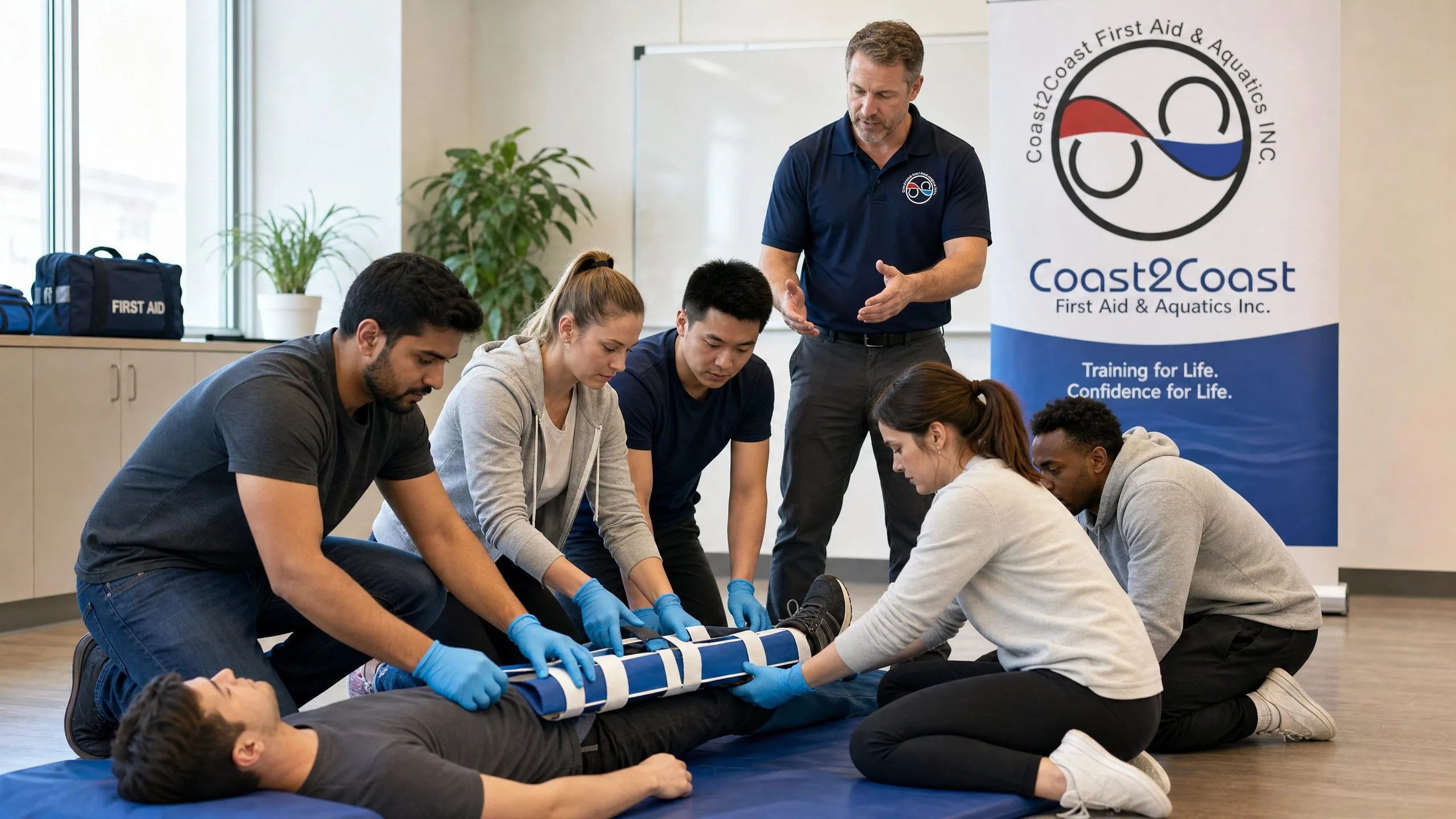
For an individual employer, the exposure is direct and easy to underestimate. A single workplace injury in Ontario carries an estimated direct cost of $39,000 to $78,000 in compensation premiums and wage supplements, and a further $78,000 to $158,000 in indirect costs: lost productivity, the scramble to cover the absent worker, replacement hiring and training, incident investigation, and administration (OSG, citing WSIB data). Under Ontario’s experience-rating system, a workplace with worse-than-average claims does not just pay once; its premiums climb and stay elevated, so a single poorly managed injury can echo through the books for years.
Put concretely: imagine a 12-person landscaping company whose designated responder holds CPR Level C. A crew member falls from a trailer and lands badly on an outstretched arm. The responder is well-trained for cardiac arrest, but this is a suspected fracture, a scenario their CPR course never addressed. Without the training to immobilize the limb and make a sound call about transport, the most likely outcomes are a worker moved in a way that worsens the injury, or a long delay while no one is sure what to do. The same injury, met by a responder with Intermediate First Aid training, is stabilized correctly in the first few minutes. The difference between those two responses is not abstract. It is measured in recovery time, in claim cost, and in whether that worker returns to the job in three weeks or three months.
To be clear about the limits: a workplace first aider cannot set a fracture or repair a ligament, and no one is suggesting they should. But the first few minutes set the trajectory. And the pattern in the data is exactly the one an employer should fear: the most expensive injury category in Canada is also the one certified responders understand worst. The injuries that cost the most are the ones workplaces are least equipped to manage at the point of contact.
The Fix Is One Working Day
For years, the case against requiring Intermediate First Aid universally rested on a single word: time. A two-day classroom course was a genuine burden for a small employer running a tight team, and a hard sell against the few hours that a CPR certificate demanded. When the comparison was two days versus an afternoon, the convenience argument carried real weight, and regulators and professional bodies set their minimums accordingly.
Blended learning has erased that objection. The Canadian Red Cross Intermediate First Aid course now runs as roughly eight hours of self-paced online study, completed on the worker’s own schedule and on any device, followed by about eight hours of hands-on classroom instruction. The online portion carries the theory; the classroom day is reserved for the physical skills that have to be practised in person. From the employer’s perspective, the cost is a single working day away from the floor, not two. The comparison that justified the low minimum no longer holds.
Set against that single day is the injury category responsible for 38% of Ontario’s WSIB claims. The arithmetic is not delicate. A single prevented or well-managed musculoskeletal claim saves an employer somewhere between $39,000 and $78,000 in direct costs alone, and the indirect costs run higher still. Training an entire team of twenty from CPR to Intermediate First Aid costs a tiny fraction of one avoided claim. For any employer currently relying on CPR-only staff as their emergency response, the return turns positive the first time the upgraded training keeps one injury from escalating, and everything after that is pure benefit. It is not a close call.
Coast2Coast’s testing platform adds a second layer to the argument: the ability to verify, not assume, that a certified worker actually understood what they were taught. A certificate confirms two things: that a worker attended and that they demonstrated a physical skill on the day. It says nothing about what they retained, and as the data shows, attendance and comprehension are not the same thing. By capturing question-level performance at the moment of certification, the platform shows employers exactly where understanding held and where it did not.
That capability also points to the longer-term solution for the acquisition gap the data exposes. If a quarter of students leave a course without consolidating bone and muscle injury content, the answer is not to lower the standard. It is to identify exactly which concepts are not landing and reinforce them, through targeted review, refresher modules, or recertification cycles that emphasize the highest-failure topics. Coast2Coast is using its own data for precisely this: routing the worst-performing questions back to instructors and curriculum developers so the training itself improves. A certification becomes a measurable standard of readiness rather than a one-time event, which is what a designated workplace responder should be held to in the first place.
What Must Change, and Who Must Act
Every strand of this report pulls in the same direction: the injuries Canadian workplaces produce most are the ones their responders are least prepared for, the comprehensive course that fixes that is now a single day, and the means to confirm it works already exists. This is not a call for a study or a working group. It is a call to change the standard. A CPR certificate should no longer stand in for genuine workplace first aid preparedness. Three groups can act on that now.
Provincial OHS bodies and licensing bodies: raise the floor to Intermediate First Aid.
The first aid regulations in Ontario, Alberta, and Nova Scotia, and the CPR-only requirements set by professional bodies in fitness, sport, dentistry, and municipal recreation, were calibrated to an older, more burdensome version of the course. The minimum they set should reflect the injury reality of Canadian workplaces, not the training logistics of a decade ago.
Employers: don’t wait for the regulation.
If your designated responders hold only CPR, they are unprepared for your most probable emergency. Upgrading to Intermediate First Aid costs one working day per person and covers the injuries, bone, muscle, joint, spinal, that drive the majority of your compensation costs. One avoided claim more than pays for training an entire team. Private group training makes this straightforward for teams of any size.
Training providers: measure knowledge, not just attendance.
A certificate that confirms only that a worker showed up is not enough. Coast2Coast’s platform is the first in North American first aid training to capture written-exam performance at scale. The industry should not claim that certification guarantees competency while using no mechanism to measure it.
For Ontario employers confirming their current obligations or upgrading their team’s certification level, the WSIB compliance page covers current regulatory requirements in detail.
Why This Research Exists
“I passed my first first aid course at 19. I had the card. When I was finally asked to perform, a practical assessment for an emergency response team at the University of Toronto, I froze. The certificate said I was ready. I wasn’t. That gap between holding a card and actually knowing what to do is why Coast2Coast exists, and why we built the technology to measure it at scale. Our data finally puts a number on it. It is larger than most employers would guess.”
Ashkon Pourheidary, Founder, Coast2Coast First Aid, B.Sc. (Hons) Neuroscience, University of Toronto
Upgrade Your Certification
Get Certified in Intermediate First Aid
One working day in-class. Covers everything CPR leaves out. Canadian Red Cross certified.
Team Training
Book Group Training for Your Whole Team
On-site or at a Coast2Coast facility. Schedule around your operations.
Key Takeaway
Coast2Coast First Aid’s analysis of 539,821 exam responses from 20,000+ students found that bone, muscle, and joint injuries produced the highest wrong-answer rate (27.7%) of any knowledge area tested, while CPR produced the lowest (8.6%). Workers certified in CPR only receive no instruction in the injury category their workplace is most likely to produce, and that category accounts for 38% of Ontario WSIB claims. Intermediate First Aid (formerly Standard First Aid) closes that gap in one working day of in-class instruction, and its blended format means the two-day classroom barrier that long justified the CPR-only minimum no longer exists.
WSIB Compliance
Is Your Workplace First Aid Program Up to Date?
Verify your WSIB Regulation 1101 obligations and close any gaps before your next inspection.
Frequently Asked Questions: First Aid Knowledge Gap Canada 2026
Q1: Is CPR certification enough to meet workplace first aid requirements in Canada?
A: Not for most workplaces. CPR certification covers cardiac arrest, AED use, and major bleeding control. It does not cover bone, muscle, and joint injuries, head and spinal injuries, burns, seizures, strokes, or diabetic emergencies. Canadian provinces set their own thresholds, but most workplaces above a basic headcount or hazard level require at least one person certified in a comprehensive first aid course. CPR-only certification may satisfy the minimum in very small, low-hazard workplaces, but it does not prepare workers for the injury types Canadian workplaces most commonly produce.
Q2: What is the Coast2Coast first aid exam dataset?
A: The dataset covers 539,821 individual question responses from more than 20,000 students, collected between July 2025 and May 2026 across 381 distinct question-course administrations (after excluding two malformed questions). It was produced by Coast2Coast First Aid’s proprietary digital testing platform, which captures every individual answer submitted during the written exam at the end of a certification course, not just whether the student passed. To the company’s knowledge, it is the largest body of first aid knowledge-performance data ever published by a training provider in North America.
Q3: What did the exam data find about CPR knowledge?
A: CPR and defibrillation had the lowest wrong-answer rate in the dataset at 8.6% across 53,534 attempts. Workers who completed comprehensive first aid training answered CPR questions correctly the large majority of the time. This is the category CPR training was designed for, and the data confirms it works. The concern is not CPR knowledge, but the gaps in every other knowledge area, particularly bone, muscle, and joint injuries at 27.7%.
Q4: Which knowledge area had the highest wrong-answer rate?
A: Bone, muscle, and joint injuries had the highest wrong-answer rate at 27.7% across 13,684 attempts. This category includes fractures, sprains, strains, and dislocations, the injury types most commonly produced in Canadian workplaces and the leading driver of WSIB compensation costs in Ontario. It is also the category that CPR training does not cover at all. Workers with CPR-only certification have no trained response for these injuries.
Q5: What two exam questions did the most responders get wrong?
A: Two questions stood out in the dataset. When should you apply a sling or splint for a bone, muscle, or joint injury? was answered incorrectly by 33.6% of respondents across 8,279 attempts. What should you do if the dressing on a penetrating chest wound becomes saturated? was answered incorrectly by 44.1% across 8,279 attempts. Both questions test foundational response decisions that a designated workplace first aider would be expected to make on the job. Both were missed by a significant portion of students on the day they certified.
Q6: What does CPR Level C cover that CPR Level A does not?
A: CPR Level A covers cardiac arrest response, AED use, and choking management for adults only. CPR Level C adds the same skills for children and infants, plus management of major life-threatening bleeding such as tourniquet application. Level C is the more common workplace CPR credential in Canada. Neither level covers bone, muscle, and joint injuries, head and spinal injuries, burns, seizures, strokes, or the secondary assessment skills taught in a comprehensive first aid course.
Q7: What is Intermediate First Aid and how is it different from CPR certification?
A: Intermediate First Aid (formerly Standard First Aid) is the comprehensive Canadian Red Cross first aid certification that meets the CSA Z1210 national standard. It covers everything CPR Level C covers and adds bone, muscle, and joint injury response, head and spinal injury assessment, wound care, burns, poisoning, seizures, strokes, diabetic emergencies, severe allergic reactions, and structured secondary assessment. The in-class component is approximately eight hours, equivalent to one working day, following roughly eight hours of self-paced online study completed before the classroom session.
More FAQs: Workplace First Aid Requirements and Certification
Q8: How long does Intermediate First Aid take to complete?
A: Intermediate First Aid (formerly Standard First Aid) uses a blended format: approximately eight hours of self-paced online study followed by approximately eight hours of hands-on classroom instruction. The online portion is completed at the student’s own pace before the classroom day. From an employer’s perspective, the impact on scheduled work time is one working day. The two-day classroom format that was standard until recently is no longer the delivery method for this course.
Q9: Does Ontario require Intermediate First Aid in the workplace?
A: In Ontario, WSIB Regulation 1101 sets out workplace first aid requirements. Intermediate First Aid (formerly Standard First Aid) is required for workplaces above certain headcount and hazard thresholds. Smaller or lower-risk workplaces may meet their obligation with Basic First Aid (formerly Emergency First Aid). As of June 2026, WSIB has updated the program names to align with the CSA Z1210:24 national standard. Employers should confirm their current obligation directly at wsib.ca.
Q10: Is a CPR card valid for WSIB workplace first aid compliance in Ontario?
A: No. CPR certification alone does not satisfy WSIB workplace first aid requirements in Ontario. WSIB Regulation 1101 requires a recognized first aid certificate, either Basic First Aid or Intermediate First Aid depending on workplace size and hazard level, issued by an approved training provider. CPR certification may be required as a component of those courses, but it is not a substitute for a full first aid certification under the Regulation.
Q11: What are musculoskeletal disorders and why do they matter for workplace first aid?
A: Musculoskeletal disorders are injuries to muscles, tendons, ligaments, joints, and bones, including sprains, strains, and fractures. They are the most frequent type of lost-time injury in Canada according to the Canadian Centre for Occupational Health and Safety, and the leading source of lost-time compensation costs. In Ontario, sprains and strains alone accounted for 38% of all WSIB claims in 2023. These are the injuries CPR training does not address, and the injuries that produced the highest wrong-answer rate in the Coast2Coast exam dataset.
Q12: What does a high wrong-answer rate on a first aid exam mean in practice?
A: The wrong-answer rate measures the proportion of students who answered questions in a category incorrectly on the day they certified, immediately after completing the course. A 27.7% wrong-answer rate for bone and muscle injuries means that more than one in four trained graduates did not correctly answer those questions at the moment of certification. This is not a measure of what happens years later when memory fades. It reflects the limits of first-exposure learning. For CPR-only certified workers, there is no rate to measure for that category, because the content was never taught.
Q13: Are employers required to upgrade CPR-only workers to Intermediate First Aid?
A: Whether an employer is required to do so depends on the province, the number of workers, and the workplace hazard level. In Ontario, WSIB Regulation 1101 sets specific thresholds at which Intermediate First Aid is required. In Alberta, OHS Code Part 11 determines requirements by headcount, hazard classification, and distance from medical aid. Regardless of the regulatory floor, employers in industries that produce frequent musculoskeletal injuries, such as trades, fitness, recreation, and manufacturing, benefit substantially from certifying their responders at the Intermediate First Aid level.
Q14: Can employers request on-site group training for Intermediate First Aid?
A: Yes. Coast2Coast First Aid offers private group training for organizations that want to certify a team at their own location or at a Coast2Coast facility. Group training allows employers to schedule around operational needs and certify multiple workers in a single session, reducing per-person time and cost. The course curriculum and certification issued are identical to those from public scheduled sessions.
Q15: Where can I read the full Coast2Coast first aid knowledge gap research report?
A: The full report, including complete methodology, question-level data, and all cited sources, is available at c2cfirstaidaquatics.com/canada-first-aid-knowledge-gap-report. The anonymized question-level methodology is available to researchers and journalists on request by contacting ashkon@c2cfirstaidaquatics.com.
About Coast2Coast First Aid
Coast2Coast First Aid is an authorized Canadian Red Cross Training Partner and Canadian Heart and Stroke Foundation Authorized Training Site, operating 37+ locations across Ontario and Alberta. Founded in 2014, it has certified more than 150,000 people in Intermediate First Aid, CPR, AED, and related programs. Its proprietary digital testing platform, the first of its kind in North American first aid training, has captured more than 539,000 exam responses from 20,000+ students, the largest first aid knowledge dataset published by any provider on the continent.
Author and Reviewer: Ashkon Pourheidary, B.Sc. (Hons) Neuroscience, University of Toronto. Co-Founder and Canadian Red Cross Instructor Trainer since 2011. Coast2Coast makes its anonymized question-level methodology available to researchers and journalists on request: ashkon@c2cfirstaidaquatics.com.
Sources
- CCOHS, Government of Canada, April 2024. 348,747 accepted lost-time claims in Canada (2022); musculoskeletal disorders as leading lost-time injury type.
- Workplace Safety Prevention Services (WSPS), citing WSIB data, February 2026. Sprains and strains as 38% of all Ontario WSIB claims (2023).
- WorkSafeBC, February 2026. Musculoskeletal injuries as approximately 30% of time-loss claims; $2.35 billion in claims (2020 to 2024).
- OSG, citing WSIB data. Direct ($39K to $78K) and indirect ($78K to $158K) cost per Ontario workplace injury.
- Innovation, Science and Economic Development Canada, Key Small Business Statistics 2025. Micro-enterprises (1 to 4 employees) as 59.1% of Canadian employer businesses.
- Canadian Red Cross course descriptions; CSA Z1210. Intermediate First Aid and CPR/AED Level C curriculum scope and blended format hours.
- WSIB Ontario, Regulation 1101 and June 2026 program update.
- Government of Alberta, OHS Code Part 11: First Aid.
- Province of Nova Scotia, Workplace First Aid: A Guide for Employers and First Aiders (N.S. Reg. 43/2022).
- Coast2Coast First Aid digital testing platform, July 2025 to May 2026. 539,821 question responses from 20,000+ students. Primary research source; full methodology available on request.
Press Assets