
Quick Answer
To obtain CPR and first aid certification in California, you must enroll in a course that matches your professional requirements, complete the training, and pass an in-person hands-on skills evaluation. California’s Cal/OSHA and EMSA regulations require a practical skills component for all occupational certifications 100% online courses do not satisfy these requirements. Certifications are typically valid for two years, after which a renewal or recertification course is required to maintain compliance.
What You Will Learn in This Guide
- Why California law and Cal/OSHA require a hands-on practical component for CPR and first aid certification
- Which certification level applies to your specific role general workplace, healthcare provider, teacher, or childcare worker
- How EMSA-approved Pediatric First Aid and CPR requirements differ from standard adult courses
- What blended learning means and whether it satisfies California’s occupational certification standards
- How long certifications last, when to schedule renewal, and what happens if your certification lapses
- What skills are covered in each course level, from basic adult CPR to Basic Life Support for healthcare professionals
Getting CPR and first aid certification in California is more than a professional requirement. It is a commitment to building real life saving skills that can determine whether someone survives a cardiac emergency or serious injury. California’s regulatory landscape is specific: both Cal/OSHA and the California Emergency Medical Services Authority (EMSA) set clear standards for what counts as a valid certification depending on your role. Understanding those requirements before you enroll saves time, ensures compliance, and guarantees that your certificate will be accepted by your employer, licensing board, or school district.
This guide to CPR and first aid certification in California explains every major certification pathway available, from general workplace training to EMSA-approved Pediatric courses for childcare providers and Basic Life Support for healthcare professionals. Whether you are learning CPR for the first time or renewing an existing certificate, it covers what hands-on assessment involves, how blended learning works, and how to keep your certification current over time.
Why Does California Require a Hands-On Skills Assessment for CPR Certification?
California’s regulations mandate that CPR and first aid certification include a hands-on skills assessment. This requirement applies to virtually all occupational certifications recognized by Cal/OSHA and EMSA. The reason is straightforward: cardiopulmonary resuscitation is a physical skill. Watching a video or completing online modules builds knowledge, but it does not build the muscle memory needed to deliver effective chest compressions, operate an automated external defibrillator, or manage a choking patient under stress.
Cal/OSHA Title 8, Section 8351 requires that designated first aid personnel in California workplaces be trained through an approved program that includes practical demonstration. This means that 100% online courses do not meet California’s occupational certification requirements. To receive a certification that satisfies Cal/OSHA, an employer’s safety plan, or a professional licensing board, you must attend an in-person skills session and pass an instructor assessment.
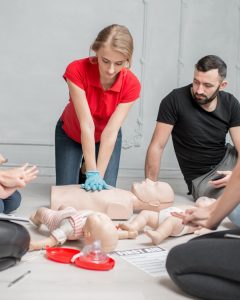
Early CPR performed correctly can double or triple survival rates in out-of-hospital cardiac arrests. Communities with higher concentrations of trained individuals consistently show better outcomes for cardiac emergencies. That outcome depends entirely on quality and quality is built through hands-on practice with manikins, AED trainers, and direct feedback from a certified instructor.
Cal/OSHA Compliance Note
General workplace training under Cal/OSHA requires adult CPR, AED, and basic first aid to be completed with a hands-on instructor assessment. Certifications earned through 100% online-only formats do not satisfy this requirement. Verify that any course you register for includes a live, in-person practical skills component before enrolling.
What Are the Different CPR and First Aid Certification Levels in California?
California does not use a single universal certification standard. The correct course level depends on your profession, workplace risk classification, and any requirements set by your licensing body. Understanding the available pathways before enrolling prevents the common mistake of completing a course that does not satisfy your specific employer or regulatory requirement.
General Workplace: Cal/OSHA Compliant First Aid and CPR
The baseline requirement for most California workplaces is a course that covers adult CPR, automated external defibrillator use, and basic first aid skills, including wound care, shock recognition, and response to common medical emergencies such as allergic reactions and seizures. This training must include a hands-on assessment with a certified instructor to qualify as OSHA-approved. Local authorized training facilities throughout California administer both American Heart Association and American Red Cross curricula, issuing the specific certificates and stickers mandated by the state.
Standard first aid training at this level typically runs one to two days depending on the scope of coverage. Basic-level courses focus on immediate lifesaving skills suitable for low-risk workplaces, while more comprehensive intermediate-level courses cover advanced trauma scenarios and are the standard for higher-risk environments including construction, industrial settings, and larger organizations.
EMSA-Approved Pediatric First Aid and CPR for Childcare Providers
State-licensed daycare providers in California face a more specific requirement. The California Emergency Medical Services Authority mandates that childcare workers complete a specialized 8-hour Pediatric First Aid and CPR course approved by EMSA. This course goes beyond standard adult CPR to cover infant CPR, child CPR, pediatric choking response, and the medical emergencies most likely to occur in a childcare setting.
Specialized EMSA-approved childcare certifications are available at authorized training centers across California. The 8-hour requirement is the minimum, and some licensing situations may require additional components. Childcare providers should verify their specific licensing requirements with the California Department of Social Services before choosing a course.
Teacher Certification: California Commission on Teacher Credentialing
The California Commission on Teacher Credentialing requires school teachers to hold current certification in Adult, Child, and Infant Pediatric CPR, AED, and first aid. This means that a general adult-only CPR course is not sufficient for teacher credentialing purposes. The certification must explicitly cover all three patient populations: adult, child, and infant. Most comprehensive CPR and AED courses designed for the general public do cover all three age groups, but it is worth confirming this before enrolling.
Basic Life Support for Healthcare Professionals
Basic Life Support is a specialized CPR course designed for healthcare providers and first responders. It differs from standard CPR training in several important ways: BLS focuses on high-quality CPR technique, AED use in clinical environments, advanced airway management principles, and team dynamics during resuscitation efforts. The American Heart Association’s BLS certification is the most widely recognized standard for healthcare professionals in California.
Basic Life Support training typically lasts four to five hours and includes a rigorous hands-on skills component. BLS certifications are generally valid for two years, though some healthcare employers and hospital credentialing bodies require annual renewal. Healthcare workers should confirm their employer’s specific BLS recertification timeline rather than assuming the standard two-year cycle applies.
| Certification Level | Who Requires It | Duration | Valid For |
|---|---|---|---|
| General Workplace (Cal/OSHA) | Most California employers; retail, office, industrial | 1-2 days | 2 years |
| EMSA Pediatric (Childcare) | State-licensed daycare and childcare providers | 8 hours minimum | 2 years |
| Teacher Credentialing (CTC) | K-12 teachers; coaches; school staff | 4-6 hours | 2 years |
| Basic Life Support (BLS) | Healthcare providers; nurses; paramedics | 4-5 hours | 2 years* |
*Some healthcare employers require BLS renewal annually. Confirm with your employer or credentialing body.
What Skills Are Covered in a CPR and First Aid Course?
A comprehensive CPR and first aid course builds both knowledge and practical competency. The specific skills covered vary by course level, but the core components common to all general workplace and public certifications include the following areas.
Cardiopulmonary Resuscitation (CPR)
CPR training covers adult, child, and infant CPR techniques, including correct hand placement, compression depth and rate, and the appropriate ratio of compressions to rescue breaths. Learning CPR through hands-on repetition develops the life saving skills and muscle memory needed to act with confidence under stress. High-quality CPR delivered at the right depth and rate without unnecessary interruptions is the single most important factor in improving survival rates for cardiac arrest. Courses include extensive practice on manikins so that learners develop physical technique, not just theoretical knowledge.
Automated External Defibrillator (AED) Training
AED training teaches participants how to power on a device, attach electrode pads correctly, follow audio and visual prompts, deliver a shock safely, and resume CPR immediately after shock delivery. Modern AEDs are designed to guide the user step-by-step, but hands-on practice with AED trainers builds the confidence to use one quickly in a real cardiac emergency. The combination of immediate CPR and early defibrillation significantly improves outcomes compared to either intervention alone.
First Aid Skills: Bleeding, Choking, Shock, and Medical Emergencies
First aid training covers a broad range of emergency scenarios. Wound care modules teach how to control bleeding using direct pressure and bandaging, and how to recognize when more advanced intervention is required. Choking response training covers abdominal thrusts for conscious adults and children, as well as back blows for infants. Shock management teaches recognition of early shock signs including pale skin, rapid breathing, and altered consciousness.
Courses also address medical emergencies including allergic reactions and anaphylaxis, seizure management, stroke recognition using the FAST method (Face, Arms, Speech, Time), and diabetic emergencies. Heartsaver CPR, AED, and First Aid courses offered through the American Heart Association are designed specifically for individuals with little or no medical background and cover adult, child, and infant scenarios as well as common injuries and medical emergencies in everyday settings.
How Does Blended Learning Work for CPR Certification in California?
Blended learning is a course delivery format that splits the training into two components: an online theory portion that participants complete at their own pace, followed by an in-person practical skills session with a certified instructor. Participants who get certified online through a blended format receive the same Red Cross or AHA certification as those who complete a fully in-person course, because the practical skills assessment requirement is still met. This format is widely accepted for both American Red Cross and American Heart Association certifications and satisfies Cal/OSHA’s requirement for a hands-on assessment, unlike fully online courses, which do not.
The online theory portion typically takes two to three hours and covers the science behind CPR, AED use, and first aid techniques. Participants can complete this portion on any device and on their own schedule, making it practical for working professionals with a busy schedule. Many people choose blended CPR classes specifically because they allow the theoretical foundation to be built at home while the hands-on component is reserved for the live session. The in-person component follows and usually runs an additional two to three hours, during which participants practice skills on manikins and AED trainers under instructor supervision and complete a hands-on assessment to confirm competency. Those who get certified online through this format receive a digital certificate the same day as their in-person session upon successful completion.
For California-specific roles, blended learning satisfies most occupational requirements provided the in-person component is completed with a locally authorized training facility. The American Red Cross is one of the primary providers of OSHA-compliant blended learning options in the United States, and its format is accepted by most California employers. The AHA’s Heartsaver courses are also available in blended formats for general workplace and public certifications.
In California, getting certified online is accepted for many roles that do not require specific AHA or EMSA certifications. However, roles governed by Cal/OSHA, EMSA, the California Commission on Teacher Credentialing, or individual healthcare licensing boards all require the in-person skills component. When in doubt, confirm with your employer or licensing body before enrolling in an online-only course.
How Long Is CPR and First Aid Certification Valid in California?
CPR and first aid certifications are typically valid for two years from the date of successful completion. This applies to general workplace certifications, EMSA-approved childcare certifications, and standard AHA and Red Cross certifications. After two years, a renewal or recertification course is required to maintain compliance.
When Should You Schedule Your Renewal?
It is recommended to schedule your CPR renewal three to four months before your certification expiration date. This buffer ensures that if a course session is full or your schedule is disrupted, you still have time to complete renewal before the certificate lapses. Leaving renewal until the final weeks before expiration creates unnecessary compliance risk, particularly for workers in regulated industries where a lapsed certification may mean temporary removal from duties.
What Happens If Your Certification Has Expired?
For certifications expired by fewer than 90 days, many providers offer a shorter recertification or skills check course rather than the full initial course. For certifications expired by more than 90 days, individuals generally need to complete a full initial course rather than a recertification. The exact policy varies by provider and certification type. Confirm with your training provider before booking to ensure you register for the correct format.
Healthcare workers holding BLS certification should pay particular attention to renewal timelines, as some hospital and clinical employers require renewal before the two-year mark and will not accept a certification that is within the final 90 days of its validity period.
How Do You Get CPR and First Aid Certified in California? Step-by-Step
The process for obtaining CPR and first aid certification in California follows a consistent series of steps regardless of which course level or delivery format you choose.
Step 1: Identify the correct certification for your role. Review the requirements from your employer, licensing board, or regulatory authority. Confirm whether your role requires a general Cal/OSHA-compliant course, an EMSA-approved Pediatric course, a CTC-compliant teacher certification, or BLS for healthcare providers. Enrolling in the wrong level can mean the certificate is not accepted.
Step 2: Choose a course format and authorized provider. Decide between full in-person CPR classes and blended learning. Blended learning offers flexibility for the theory component while still satisfying the in-person skills requirement. Confirm that the provider is an authorized training facility for either the American Red Cross or American Heart Association curriculum, as local facilities are approved to issue the state-recognized certificates and stickers required in California.
Step 3: Complete the training and pass the skills assessment. Attend your course, participate fully in the hands-on practice sessions, and complete the instructor-led skills assessment. Successful completion requires demonstrating competency in the practical skills, not just answering a written test. Coast2Coast’s California course locations deliver OSHA-compliant training with same-day digital certificate delivery upon successful completion.
Step 4: Maintain your certification. Track your expiration date and schedule renewal three to four months in advance. Keep a digital and physical copy of your certificate accessible to your employer or licensing body.
Key Takeaway
CPR and first aid certification in California requires more than completing an online module. Cal/OSHA, EMSA, and other state regulatory bodies all mandate an in-person hands-on skills assessment for occupational certification. Choosing the correct course level for your role whether that is a general workplace course, an EMSA-approved Pediatric course, a teacher credentialing course, or BLS for healthcare providers and renewing before your certificate expires are the two most important steps for staying compliant and prepared.
Ready to Get Certified?
Coast2Coast offers Cal/OSHA-compliant, EMSA-approved, and BLS courses across California with same-day digital certification upon successful completion.
Frequently Asked Questions: 2025 CPR and First Aid Certification in California
Sources and Regulatory References
- California Code of Regulations, Title 8, Section 8351 First Aid Requirements for California Workplaces (Cal/OSHA)
- California Emergency Medical Services Authority (EMSA) Pediatric First Aid and CPR Standards for Childcare Providers
- California Commission on Teacher Credentialing (CTC) CPR and First Aid Requirements for Teaching Credentials
- American Heart Association 2020 Guidelines for CPR and Emergency Cardiovascular Care (Circulation, 2020)
- American Red Cross First Aid, CPR, and AED Program Standards
- Occupational Safety and Health Administration (OSHA) Medical and First Aid: General Industry Standard 29 CFR 1910.151
This article was reviewed for clinical and regulatory accuracy. Regulatory requirements are subject to change; readers should verify current standards directly with the applicable California or federal authority.