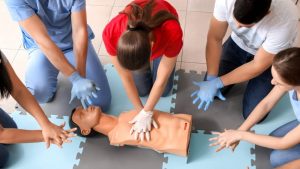

Yes, first aid and CPR training saves lives. CPR training can double or triple a cardiac arrest victim’s chance of survival. When bystander CPR begins immediately and an AED is used within three minutes, survival rates can exceed 70 percent. In Canada, approximately 35,000 out-of-hospital cardiac arrests occur annually. Every minute without CPR reduces survival odds by 7 to 10 percent. First aid and CPR training essentials include emergency scene management, CPR and AED use, airway intervention, and trauma care, making trained bystanders the critical link in the chain of survival.
✓ Nationally Recognized Certification
Find a First Aid Course Near You
Emergency First Aid, Intermediate / Standard First Aid, CPR Level C, and BLS courses at 30+ locations across Canada. Be the link that saves a life.
First Aid and CPR Training Essentials: The Chain of Survival
The question sounds rhetorical, but it deserves a direct answer backed by data. Yes. First aid and CPR training saves lives, and the evidence from Canadian and international research is unambiguous. CPR training equips individuals with essential skills to respond effectively in cardiac emergencies, potentially doubling a victim’s chance of survival. Essential first aid and CPR training provides skills to act as a crucial link in the chain of survival before professional emergency medical services arrive. The gap between a cardiac arrest and the arrival of a paramedic is often the window in which a trained bystander determines whether a person lives or dies.
In Canada, approximately 35,000 out-of-hospital cardiac arrests occur annually. Without bystander intervention, survival rates hover between 5 and 10 percent. With immediate bystander CPR, that rate can double or triple. When CPR is combined with early defibrillation using an Automated External Defibrillator within three to five minutes, survival rates can reach 70 percent or higher. These are not theoretical numbers. They represent real people in real emergencies whose lives were saved because someone nearby had the knowledge, the skills, and the confidence to act quickly.
The chain of survival consists of four links: early recognition and call for help, early CPR, early defibrillation, and early advanced care. Each link depends on the previous one. Bystander CPR is the second link and the one most dependent on community training. If any link breaks, survival odds fall sharply. CPR maintains artificial circulation and respiration to prevent permanent brain damage during cardiac arrest. Irreversible neurological damage begins within four to six minutes of cardiac arrest. The average emergency medical services response time in urban Canada ranges from six to ten minutes. This gap is precisely where trained bystanders, equipped with essential life-saving skills, become the deciding factor.
How CPR Saves Lives: The Science of Cardiopulmonary Resuscitation
Cardiopulmonary resuscitation works by manually compressing the heart to push blood through the circulatory system when the heart has stopped beating on its own. Each compression delivers a small but critical volume of oxygenated blood to the brain, buying time until the heart can be restarted by defibrillation or advanced medical intervention.
The recommended compression-to-breath ratio in CPR is 30 chest compressions followed by 2 rescue breaths, unless performing Hands-Only CPR. When performing CPR on adults, compressions must be delivered at a rate of 100 to 120 compressions per minute and at a depth of at least 2 inches (5 cm), while allowing full chest recoil between each compression. Hands-Only CPR focuses on continuous chest compressions for those untrained or uncomfortable with mouth-to-mouth ventilation, and is highly effective as a first response in cardiac arrest situations.
Recognition of medical emergencies is the first step. This includes identifying the signs of heart attacks, strokes, severe allergic reactions, and knowing how to assist with an EpiPen. The first aid protocol Check, Call, Care involves surveying the scene for safety, calling emergency services, and providing immediate care based on the victim’s injuries. The Universal Precautions in first aid, including the use of protective equipment such as disposable gloves and CPR barrier devices, protect both rescuer and victim and remove a significant psychological barrier to bystander action.
CPR Level C and Hands-On Practice: Why Technique Determines Outcomes
CPR Level C is the Canadian Red Cross standard for most workplace and community certifications. It covers adult, child, and infant CPR, making it suitable across age groups and emergency situations. The effectiveness of CPR is directly tied to the quality of technique. Research indicates that CPR skills can deteriorate significantly without regular hands-on practice, with retention beginning to decline as early as three to six months after initial training.
Hands-on practice with realistic manikins during CPR courses provides participants with the opportunity to receive real-time feedback on their compression depth and rate, which is crucial for mastering the skills needed in real emergencies. Effective rescue breaths, proper hand placement, and full chest recoil are skills that cannot be developed through theory alone. They require repetition under the guidance of experienced instructors in real-life scenario training. Effective first aid relies not only on physical techniques but also on critical soft skills, including situational awareness, clear communication, and composure during crises.
Basic Life Support for Healthcare Providers
For healthcare professionals, Basic Life Support takes CPR training to a clinical level. BLS covers two-rescuer CPR, bag-valve-mask ventilation, team-based resuscitation, and opioid overdose response. It is designed for nurses, paramedics, physicians, and dental staff who may encounter life-threatening emergencies in clinical settings. BLS certification is required by most hospitals, dental offices, physiotherapy clinics, and long-term care facilities across Ontario, and must be renewed annually.
Does Intermediate / Standard First Aid Save Lives Beyond Cardiac Arrest?
The evidence for first aid saving lives extends well beyond cardiac arrest. Severe bleeding, anaphylaxis, choking, stroke, and environmental emergencies all carry significant mortality risk when untreated in the first few minutes. The essential components of first aid and CPR training encompass emergency scene management, basic life support including CPR and AED use, airway emergency intervention, and trauma care. Each of these components addresses a category of emergency where timely bystander intervention directly impacts survival.
Uncontrolled hemorrhage is one of the leading causes of preventable death from trauma. A person trained in wound care and bleeding control can apply direct pressure, use a tourniquet where appropriate, and keep a victim alive until paramedics arrive. Similarly, a person experiencing anaphylaxis has a survival window of minutes without epinephrine. A trained bystander who knows how to assist with an EpiPen and recognize the signs of a severe allergic reaction can bridge that gap.
Real Life Scenarios: What First Aid Training Prepares You For
Intermediate / Standard First Aid training prepares people to respond confidently in a wide range of real life scenarios: a coworker who collapses during a meeting, a child who chokes at a family dinner, a cyclist who suffers a head injury on a trail, or an older adult who shows signs of stroke at a community event. These are not rare occurrences. Sudden medical emergencies happen in homes, workplaces, schools, and public spaces every day across Canada.
Training with realistic manikins and scenario-based practice builds muscle memory. It transforms knowledge into instinct. When an emergency happens in real life, a trained responder does not need to think through each step. The response is automatic, fast, and effective. This is the fundamental difference between reading about first aid and completing a hands-on course with experienced instructors.
Occupational First Aid Level Requirements Across Canada
The evidence that first aid training saves lives is reflected in the legal requirements that govern Canadian workplaces. Every province has occupational first aid level requirements tied to workforce size and industry hazard level. In Ontario, WSIB Regulation 1101 requires Emergency First Aid for workplaces with up to five employees and Intermediate / Standard First Aid for workplaces with six or more. In British Columbia, as of November 2024, all workplaces must complete a formal first aid assessment. Alberta requires employers to use only approved training providers to issue recognized certifications. Many workplaces exceed the minimum to ensure a certified responder is accessible within two minutes of any incident, the WSIB 120-second rule.
Learn This Skill in a Real Classroom
Intermediate / Standard First Aid with CPR Level C
Two-day comprehensive Canadian Red Cross course covering cardiac arrest, severe bleeding, anaphylaxis, environmental emergencies, and spinal injuries. Meets WSIB Regulation 1101 for most Ontario workplaces.
First Aid Course Options: Choosing the Right Level
Emergency First Aid: The One-Day Course
Emergency First Aid with CPR Level C is a one-day course covering the essential life-saving skills needed for most workplaces and community settings. This includes adult, child, and infant CPR, AED use, choking management, wound care, and recognition of common medical emergencies including heart attacks, strokes, seizures, and diabetic emergencies. It satisfies Ontario’s minimum WSIB requirements for small workplaces.
Intermediate / Standard First Aid: The Comprehensive Option
The Intermediate / Standard First Aid course is a two-day comprehensive program adding head and spinal injuries, chest injuries, bone and joint fractures, poisoning and substance misuse, environmental emergencies such as hypothermia and heat stroke, and multiple-casualty incident management. It is required by employers in higher-risk industries including construction, manufacturing, mining, and outdoor recreation. Under the 2026 CSA Z1210:24 standard, Intermediate / Standard First Aid is now called Intermediate First Aid and Emergency First Aid is now called Basic First Aid.
The Evidence: First Aid and CPR Skills That Make a Measurable Difference
The numbers make the case. Bystander CPR doubles or triples survival odds from cardiac arrest. Early defibrillation within three minutes pushes survival rates above 70 percent. Every minute of delay without CPR or defibrillation reduces survival by 7 to 10 percent. First aid training reduces mortality from severe bleeding, choking, and anaphylaxis by enabling immediate bystander response before professional help arrives.
Organizations like the Canadian Red Cross standardize first aid and CPR training to ensure laypersons can stabilize a victim until professional medical help arrives. The Canadian Red Cross curriculum is built around the chain of survival model and updated regularly to reflect the latest resuscitation science. All Coast2Coast courses are delivered by certified Canadian Red Cross instructors and meet the 2026 CSA Z1210:24 standards, ensuring that every student receives nationally recognized certification with real-world applicability.
Aid certificates issued by the Canadian Red Cross are valid for three years. Research indicates that first aid and CPR skills begin to deteriorate as early as three to six months after training without practice, which is why annual refreshers are recommended even when certification remains valid. If a certification lapses, individuals must retake the full initial course instead of the shorter recertification program, making timely renewal important.
Hands-On Practice: The Difference Between Knowing and Doing
Reading about CPR does not save lives. Performing CPR saves lives. The physical skills required for effective compressions, correct depth, correct rate, full recoil, proper hand placement, and coordinated rescue breaths, cannot be developed through theory alone. They require hands-on practice with feedback from a qualified aid instructor using realistic training manikins.
This is why all Canadian Red Cross certifications require an in-person practical skills assessment. Blended learning formats allow the theory component to be completed online, but the hands-on skills session is mandatory. During this session, participants practice CPR technique, AED deployment, and scenario-based emergency response in real life simulations designed to build the muscle memory needed to act quickly and respond confidently in actual emergencies.
Flexible Training Options for Every Schedule
The evidence only translates into saved lives when people actually complete their training. Coast2Coast offers flexible training options to remove every barrier to certification. Traditional in-person courses run on weekdays, weekends, and evenings at more than 30 locations across Ontario, Nova Scotia, Alberta, and California. Blended online learning allows theory to be completed at home before a shorter in-person practical session. Private group training brings certified instructors and all aid equipment directly to your workplace or facility.
Regardless of format, every student receives the same high-quality instruction from experienced instructors and earns the same nationally recognized certification. Canadian Red Cross aid certificates are accepted by employers, licensing bodies, and regulatory authorities across Canada. Join thousands of Canadians who complete their certification with Coast2Coast each year and gain the essential skills to act as a critical link in the chain of survival.
Key Takeaway
First aid and CPR training essentials save lives. Bystander CPR doubles or triples cardiac arrest survival odds. Early AED use within 3 minutes pushes survival above 70 percent. Every minute of delay reduces survival by 7 to 10 percent. CPR skills begin to deteriorate at 3 to 6 months without practice. First aid training prepares you for cardiac arrest, severe bleeding, anaphylaxis, choking, stroke, and environmental emergencies. The chain of survival depends on trained bystanders acting as the critical second link before paramedics arrive.
Canada’s Top-Rated Training Partner
Join 150,000+ Canadians Who Are Certified
Coast2Coast is Canada’s largest Canadian Red Cross Training Partner.
4.9 stars across 20,491 Google reviews. Register online in 2 minutes.
Frequently Asked Questions: First Aid and CPR Training Essentials 2026
Q1: Does bystander CPR actually save lives?
A: Yes. CPR training equips individuals with essential skills to respond effectively in cardiac emergencies, potentially doubling a victim’s chance of survival. In Canada, approximately 35,000 out-of-hospital cardiac arrests occur annually. Without bystander CPR, survival rates hover between 5 and 10 percent. With immediate bystander CPR, that rate can double or triple. When CPR is combined with early AED use within three to five minutes, survival rates can reach 70 percent or higher.
Q2: What is the chain of survival and why does it matter?
A: The chain of survival consists of four links: early recognition and call for help, early CPR, early defibrillation, and early advanced care. Each link depends on the previous one. Bystander CPR is the second link and the one most dependent on community training. If any link breaks, survival odds fall sharply. First aid and CPR training ensures the second link holds, maintaining blood circulation to the brain until professional help arrives.
Q3: How does CPR maintain circulation during cardiac arrest?
A: CPR works by manually compressing the heart to push oxygenated blood through the circulatory system when the heart has stopped beating. Compressions must be delivered at 100 to 120 per minute, at a depth of at least 2 inches for adults, with full chest recoil between each compression. The 30 to 2 compression-to-breath ratio ensures both circulation and oxygenation. Irreversible brain damage begins within four to six minutes of cardiac arrest.
Q4: What medical emergencies does first aid training prepare you for beyond cardiac arrest?
A: Intermediate / Standard First Aid training prepares you to manage severe bleeding, anaphylaxis, choking, stroke, head and spinal injuries, chest injuries, bone fractures, environmental emergencies including hypothermia and heat stroke, poisoning, and multiple-casualty incidents. Each of these emergencies has a survival window in which trained bystander intervention directly impacts whether the victim survives or sustains permanent injury.
Q5: What is CPR Level C and who needs it?
A: CPR Level C is the Canadian Red Cross standard covering adult, child, and infant CPR with two-rescuer techniques and AED integration. It is required for most Ontario workplaces under WSIB Regulation 1101 and for professional roles including coaches, teachers, childcare workers, and security staff. CPR Level C is included in both Emergency First Aid and Intermediate / Standard First Aid courses and is the most widely accepted CPR certification across Canada.
Q6: How quickly do CPR skills deteriorate without practice?
A: Research indicates that first aid and CPR skills begin to deteriorate as early as three to six months after initial training without practice. This is why many training providers recommend annual CPR refreshers even though Canadian Red Cross certifications are valid for three years. Recertification courses refresh muscle memory, update skills to the latest guidelines, and reinforce the decision-making skills needed to manage real emergencies.
Q7: What is the difference between Emergency First Aid and Intermediate / Standard First Aid?
A: Emergency First Aid (now called Basic First Aid under CSA Z1210:24) is a one-day course covering CPR Level C, AED use, choking, wound care, and recognition of common medical emergencies. Intermediate / Standard First Aid (now called Intermediate) is a two-day comprehensive course adding head and spinal injuries, environmental emergencies, multiple-casualty management, and trauma care. Intermediate / Standard First Aid is required for higher-risk industries and workplaces with six or more employees.
More FAQs: BLS, AED, Certification, and Training Options
Q8: What is Basic Life Support and how does it differ from CPR Level C?
A: Basic Life Support is a clinical-grade resuscitation course for healthcare professionals including nurses, paramedics, physicians, and dental staff. It covers two-rescuer CPR, bag-valve-mask ventilation, opioid overdose response, and team-based emergency scenarios. BLS is valid for one year and must be renewed annually. CPR Level C is designed for the general public and workplace settings and is valid for three years as part of a first aid certificate.
Q9: Does first aid training reduce workplace injuries and deaths?
A: Yes. Workplaces with trained first aiders consistently have better outcomes in medical emergencies. WSIB Regulation 1101 requires certified first aiders in all Ontario workplaces because the evidence supports this mandate. Trained first aiders can recognize and respond to sudden medical emergencies, control severe bleeding, manage cardiac arrest, and stabilize injured workers until paramedics arrive. Many workplaces exceed the minimum to ensure the WSIB 120-second response standard is met.
Q10: Can I complete first aid and CPR training online?
A: No. While blended learning allows the theory component to be completed online at your own pace, a hands-on practical skills assessment with a certified instructor is legally required for a valid Canadian Red Cross certificate. This in-person component covers CPR technique, AED deployment, and real-life scenario practice that cannot be replicated in an online environment.
Q11: What happens if my first aid certificate expires?
A: If your certificate lapses beyond one year, you must retake the full initial course rather than the shorter recertification program. Canadian Red Cross aid certificates are valid for three years. Coast2Coast recommends setting a reminder three months before expiry. Allowing your certificate to lapse creates a compliance gap for employers and a skills gap for the certified individual.
Q12: What is Hands-Only CPR and when is it appropriate?
A: Hands-Only CPR focuses on continuous chest compressions without rescue breaths, making it appropriate for bystanders who are untrained or uncomfortable with mouth-to-mouth ventilation. It is highly effective as an immediate response to witnessed cardiac arrest in adults and maintains blood circulation to the brain until an AED or trained responder is available.
Q13: How are first aid and CPR certifications standardized in Canada?
A: The Canadian Red Cross standardizes first aid and CPR training across Canada to ensure that certified individuals can stabilize a victim until professional medical help arrives. All courses must meet the CSA Z1210:24 standard updated in 2026. Coast2Coast delivers Canadian Red Cross certified courses across 30-plus locations, and all certifications are nationally recognized and accepted by employers and regulatory bodies across every province.
Q14: What occupational first aid level do I need in my province?
A: Requirements vary by province, industry, and workforce size. In Ontario, WSIB Regulation 1101 requires Emergency First Aid for workplaces with up to five employees and Intermediate / Standard First Aid for workplaces with six or more. British Columbia requires all workplaces to complete a formal first aid assessment as of November 2024. Alberta requires use of approved training providers. Check with your provincial occupational health and safety authority to confirm the level required for your specific workplace.
Q15: Where can I get first aid and CPR certified in Canada?
A: Coast2Coast First Aid and Aquatics offers Canadian Red Cross certified Emergency First Aid, Intermediate / Standard First Aid, CPR Level C, and BLS courses across more than 30 locations in Ontario, Nova Scotia, Alberta, and California. Weekday, weekend, and evening formats are available. Blended learning and private group training options are offered for individuals and organizations. All courses meet 2026 CSA Z1210:24 standards and issue nationally recognized aid certificates upon completion.
The information in this article is for educational and informational purposes only and does not constitute medical or occupational health and safety advice. First aid and CPR certification requirements vary by province, industry, and employer. Survival statistics cited are from published research and may vary by setting. Always verify current requirements with WSIB or your provincial authority. Coast2Coast First Aid Inc. assumes no liability for outcomes resulting from reliance on information in this article.
Written and reviewed by Ashkon Pourheidary, B.Sc. (Hons) Neuroscience, Co-Founder, Coast2Coast First Aid and Aquatics. Ashkon has been a certified First Aid and CPR instructor since 2011 and an Instructor Trainer since 2013. He is a certified EMR instructor, Psychological First Aid instructor, and BLS instructor, and has served on the First Aid Council for the Canadian Red Cross. Cardiac arrest survival statistics sourced from the Heart and Stroke Foundation of Canada and peer-reviewed resuscitation literature. CPR protocols aligned with Canadian Red Cross First Aid Guidelines and CSA Z1210:24. Coast2Coast First Aid Inc. is Canada’s largest Canadian Red Cross Training Partner. Last reviewed: March 2026. Contact info@c2cfirstaidaquatics.com or 1-866-291-9121.