
Skip to content
Skip to main content
Course Dates Flexible weekday & weekend dates. Flexible weekday & weekend dates. Book your seat ›
Coast2Coast First Aid & Aquatics
Airway Management & Oxygen Therapy Training | Coast2Coast

Healthcare & Responder Training · Canadian Red Cross Training Partner

Airway Management & Oxygen Therapy

Some patients cannot hold their own airway open. Others need oxygen before anything else you do will help. This two-hour Canadian Red Cross airway management course teaches you to recognize both, then to open an airway, size and insert an adjunct properly, clear it with suction and administer supplemental oxygen. It is written for nurses, firefighters and rescue teams, and it runs entirely in class.

Google logo 4.9 Over 21K Google Canadian reviews
  • Canadian Red Cross Training Partner badge
  • 99.9% success rate of our students badge
  • 200,000 students trained in first aid and CPR badge
  • Express certificate issued within 48 hours badge

Course Detail

Canadian Red Cross Airway Management & Oxygen Therapy

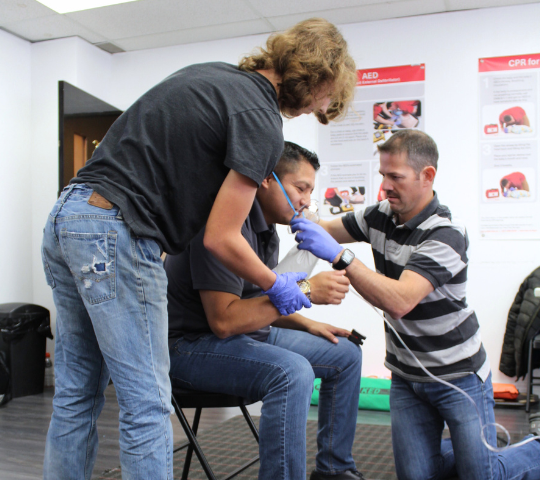
Two hours, one afternoon, all in class. You handle the oral airways, the suction device and the oxygen equipment yourself, because none of this is learned by watching. Most students book the airway management course beside a morning Basic Life Support class and finish both the same day.

Airway Management & Oxygen Therapy is a clinical skills course, not a workplace first aid certificate. Coast2Coast is a WSIB-approved training provider, but Ontario WSIB Regulation 1101 is satisfied by Basic/Emergency First Aid or Intermediate/Standard First Aid. If your employer needs a first aid certificate on file, book Intermediate/Standard First Aid as well — the majority of workplaces require Intermediate first aid certification.

Canadian Red Cross

Airway Management & Oxygen Therapy

Register Now
Teaching time

2 hours, all in class

Afternoon session, 1:30PM to 3:30PM

Who it is for

Healthcare professionals and responders

Nurses, firefighters, rescue teams, and industrial and security responders.

Evaluation
  • 100% attendance of the course
  • 75% score on the multiple choice knowledge test
Certificate

Canadian Red Cross certificate, valid 3 years

Issued within 48 hours of finishing the course.

Learn more
Course content
View all 14 course topics

Airway Management

  • Opening the Mouth
  • Cross Finger Technique
  • Tongue-Jaw Lift
  • Airway Adjuncts — Insertion and Removal
  • Oropharyngeal (OPA) Airways
  • Nasopharyngeal (NPA) Airways
  • Supraglottic Airways (awareness only)
  • Suction

Oxygen Therapy

  • Pulse Oximetry
  • Supplemental Oxygen
  • Oxygen Cylinders
  • Oxygen Regulators
  • Oxygen Delivery Devices
  • Administering Oxygen

Supraglottic airways are awareness only — you will not be certified to place one.

Learning format

Fully in person, at select Ontario facilities

No blended or online route. The whole two hours is oxygen equipment and airway adjuncts in your hands.

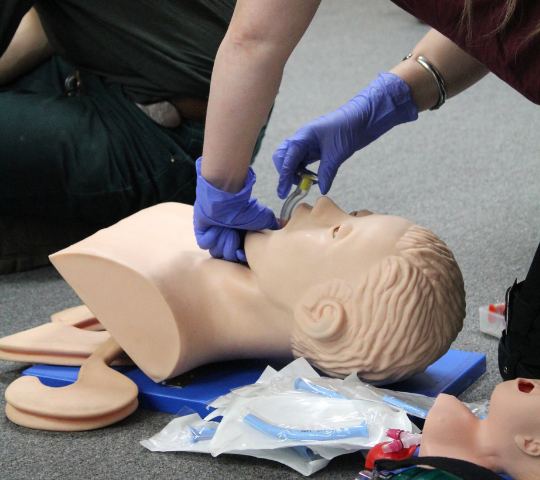
Airway Management covers the equipment you carry: sizing oral airways against the jaw, easing a nasopharyngeal airway in on a patient who still gags, clearing vomit with a suction device. Oxygen Therapy covers handling and assembling oxygen equipment properly — pulse oximeter, cylinder, regulator, flow rate, and the oxygen delivery device that suits the patient.
Register for Airway Management & Oxygen Therapy

Registration

How to Register for Airway Management & Oxygen Therapy Training

Send us the date you want and we will confirm the nearest Ontario facility running the afternoon session. Booking a team of eight or more? We will run it at your own site.

Taking Basic Life Support as well? Say so on the form and we will put both on one day.

What You Practise

Two Skill Sets in One Afternoon

The course splits down the middle. The first half is getting air in and keeping the route clear. The second half is deciding when to administer supplemental oxygen, and delivering it properly.

See the Full Syllabus

  • Opening a mouth that will not open, using the cross finger technique and the tongue-jaw lift
  • Sizing, inserting and removing oral airways — the oropharyngeal (OPA) adjuncts most kits carry
  • Inserting a nasopharyngeal (NPA) airway on a patient who still gags
  • Recognizing a supraglottic airway and knowing when one is used — awareness only
  • Clearing an airway with a suction device, and knowing when to stop

  • Reading a pulse oximeter, and what makes a reading unreliable
  • Deciding when to administer supplemental oxygen
  • Handling, assembling and storing oxygen equipment properly
  • Fitting a regulator and setting a flow rate
  • Matching the oxygen delivery device to the patient, then administering oxygen

Recommended Alongside

Basic Life Support for Healthcare Providers

Airway and oxygen skills answer one part of a clinical emergency. Basic Life Support answers the rest. Book one, and we recommend you book both.

Canadian Red Cross

Basic Life Support (BLS)

Register for BLS

A four-hour course built for healthcare professionals working in a team, where the person doing compressions is not the person on the bag-valve-mask.

Get Course Information
Teaching time

4 hours, all in class

Usually the morning, with the airway course after lunch

Who it is for

Healthcare providers who need an annual certificate

Nurses, dental professionals and students entering a clinical program. There is no prerequisite.

What it covers
  • High-performance cardiopulmonary resuscitation (CPR) in a team
  • Hands-on skills testing with automated external defibrillator
  • Bag-valve-mask ventilation and airway obstruction
  • Trauma, opioid overdose and anaphylaxis
Certificate

Canadian Red Cross certificate, valid 1 year

Shorter than the airway certificate. BLS renews annually; Airway Management & Oxygen Therapy runs three years.

Basic Life Support replaced the old CPR-HCP course. Looking for CPR for Healthcare Providers? BLS took its place — here is why.

Full BLS Course Details

Why Coast2Coast

Why Clinical Teams Book Airway Training With Us

Plenty of providers will teach you CPR. Far fewer keep oral airways, NPA adjuncts, a working suction device and oxygen equipment in the room.

Coast2Coast First Aid & Aquatics

Canadian Red Cross Training Partner

Best choice
6/6 Features met
  • Runs the Canadian Red Cross airway management course
  • Top 3 Canadian Red Cross Training Partner 2023, 2024, 2025
  • Certificate issued within 48 hours
  • Afternoon session that pairs with a morning BLS class
  • 100+ first aid and CPR courses every week
  • Private courses at your site for groups of eight or more

Other Providers

General first aid classes

0/6 Features met
  • No airway adjunct or oxygen equipment module
  • Not a ranked Red Cross Training Partner
  • 7 to 10 business days for a certificate
  • One fixed schedule
  • Limited dates and locations
  • No private group option

Testimonials

What Students Say About Our Training

Reviews From Our Students

4.9

4.9 Google rating · Over 21K Google Canadian reviews

Google Reviews

  • Black Noir Coast2Coast Student Posted on Google

    Professional and hands-on training. I truely recommend Coast2Coast.

  • Mutombo Masesa Coast2Coast Student Posted on Google

    She was knowledgeable, patient, and explained everything clearly with practical examples. She created a comfortable and engaging learning environment.

Read All Reviews on Google →

Verified Reviews from Our Students

Student Feedback

Participants across our Red Cross network.

Who It Is For

What Is Airway Management & Oxygen Therapy Training?

The airway management course sits between first aid and paramedicine. You already know how to recognize a patient in trouble. This teaches you to act on the two things that buy that patient time: a clear airway, and oxygen delivered properly. Over 150,000 participants have trained with us across North America.

  • 2 hoursTeaching time
  • 14Topics covered
  • 75%Pass mark on the knowledge test
  • 3 yearsCertificate term
See all our training locations →
  • Equipment in your hands, not on a slide

    Oral airways, suction devices, cylinders and regulators. None of the two hours goes on theory you could read at home.

  • Taught by Canadian Red Cross instructors

    First responders, nurses and other medical professionals teach our classes, and every class has a Canadian Red Cross instructor.

  • It stacks onto a BLS day

    The session runs after lunch, so you can take Basic Life Support that morning and lose one day, not two.

  • Add first aid if work requires it

    Healthcare providers often need a workplace certificate too. Our first aid training runs as a full classroom experience or as blended learning.

Private & Group Training

Train a Whole Clinical Team at Once

Groups of eight or more can run this course at their own facility. We send a Canadian Red Cross instructor and the oxygen equipment to you, on your date, at a discounted price with one centralized bill.

Every participant leaves with the same Canadian Red Cross certificate, valid three years.

Inside the Classroom

  • Airway adjuncts and oxygen delivery equipment used in the Airway Management and Oxygen Therapy course
  • Oxygen and vital signs equipment laid out in our North York training room

Where We Train

Our Ontario First Aid & CPR Training Facilities

This course runs at select Ontario facilities. Any of these sites can host a private one for your team.

Common Questions

Airway and Oxygen Questions, Answered

What is Airway Management & Oxygen Therapy training?

Airway Management & Oxygen Therapy is a two-hour Canadian Red Cross course that teaches you to open a patient's airway and administer supplemental oxygen safely. It covers manual techniques, oral airways, nasopharyngeal adjuncts, suction devices and the oxygen equipment that delivers through them.

Who should take this course?

The airway management course is written for healthcare professionals and responders — nurses, firefighters and rescue teams among them. Anyone whose kit carries adjuncts, suction devices or oxygen equipment gets the most from it.

How long does the course take?

Airway Management & Oxygen Therapy is two hours of teaching time, run as an afternoon session from 1:30PM to 3:30PM. It is fully in person, with no online portion of the training, because every topic is a physical skill.

Do I need to take Basic Life Support as well?

Basic Life Support is strongly recommended alongside Airway Management & Oxygen Therapy, and most students book both. BLS is four hours: high-performance CPR, automated external defibrillator use, trauma, opioid overdose and anaphylaxis.

What is the difference between this course and BLS?

Basic Life Support teaches you to resuscitate a patient; Airway Management & Oxygen Therapy teaches you to keep their airway open and get oxygen into them. They answer different halves of one emergency, which is why the two run back to back.

Is there a test at the end?

Yes — you need 100% attendance of the course and 75% on a multiple choice knowledge test. That 75% is the Canadian Red Cross written-exam standard.

How long is the certificate valid?

The Canadian Red Cross Airway Management & Oxygen Therapy certificate is valid for three years. Do not assume a course you pair it with matches that term: a Canadian Red Cross Basic Life Support certificate runs one year.

Does this certificate meet WSIB Regulation 1101 for my workplace?

No — Ontario WSIB Regulation 1101 is satisfied by Basic/Emergency First Aid or Intermediate/Standard First Aid, not by a clinical skills course. Coast2Coast is a WSIB-approved training provider, but that describes us rather than this certificate. Book Intermediate/Standard First Aid for workplace compliance; the majority of workplaces require Intermediate first aid certification.

Does this course cover bag-valve-mask ventilation?

Bag-valve-mask ventilation is taught in our Basic Life Support course, not in Airway Management & Oxygen Therapy. This course covers the oral airways, adjuncts and suction devices that keep a route open, and the oxygen equipment that delivers through it. Need bag-valve-mask practice too? Book Basic Life Support the same day.

Is Intermediate First Aid the same as Standard First Aid?

Yes — Intermediate First Aid and Standard First Aid are two names for one course. The Canadian Red Cross changed the wording, so older certificates read Standard and newer ones read Intermediate. See our first aid course page.

What happened to the CPR-HCP course?

Basic Life Support replaced CPR for Healthcare Providers, so CPR-HCP is no longer offered. Here is why we no longer run CPR-HCP.

Where does the course run?

The airway management course runs at select Coast2Coast facilities in Ontario. Send us your date or call 1-866-291-9121 and we will confirm the nearest site. The full Ontario list is above.

Can you run this course for my team?

Yes — we run private Airway Management & Oxygen Therapy courses for groups of eight or more, at your facility on your date. Private training comes with a discounted price and centralized billing. See private and group training.

Two hours now, for the patient who cannot breathe later

Book the airway management course at an Ontario facility, or bring it to your team.